
News
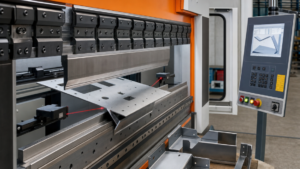
Laser Angle Measurement on an Ermaksan Power-Bend Pro
Laser angle measurement is worth considering on a high-mix Ermaksan Power-Bend Pro when springback-driven correction hits repeatedly interrupt production. It is less useful when the actual loss comes from tooling, flat blanks, gauging, deflection, or programming.
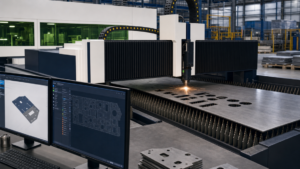
HSG G3015X 6KW for Cut-to-Bend Sheet Metal
The HSG G3015X 6KW fits a cut-to-bend operation when recurring sheet-metal work fits its 5×10 format and the shop has a deliberate plan for nesting, part identification, denesting, staging, tooling, and press-brake programming.
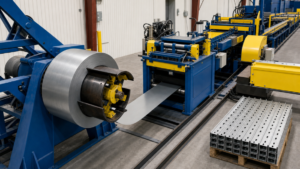
Coil-Punching Line Fit for Perforated Purlins
An integrated coil-punching line fits recurring perforated purlin work when coil width, hole patterns, cut lengths, and downstream forming rates are stable enough to justify one coordinated material path.
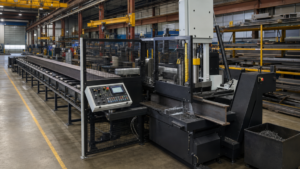
HYDMECH V-18APC-60-60 for Structural Steel Miter Cutting
The HYDMECH V-18APC-60-60 fits a defined structural-saw modernization when repeat miter cuts, square-tube bundles, and manual stock repositioning are the main bottlenecks. Its fit depends on angle-specific capacity, material flow, floor layout, and downstream requirements.
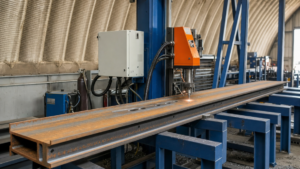
Akyapak 3 ADM VENERA for Weld-Access Beam Preparation
The Akyapak 3 ADM VENERA is worth evaluating when structural members repeatedly need multi-face drilling plus chamfering or rathole-style weld-access preparation. This guide explains when that capability changes the choice over a standard 3 ADM or 3 ADM ECO.
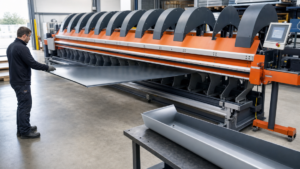
Stefa VHB/VH or a Gutter Roll Former?
The Stefa VHB/VH long-folder family fits variable commercial-gutter and trim work, while a dedicated gutter roll former is better suited to high-volume repeat profiles made continuously from coil.
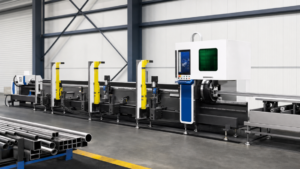
New Automated Tube Laser: Preventive Maintenance
A new automated tube laser should enter the maintenance program as a complete tube-processing cell, not as a laser source with a few add-ons. The loader, chucking, cutting head, cooling, filtration, controls, records, and service plan all influence whether the added capacity remains productive.
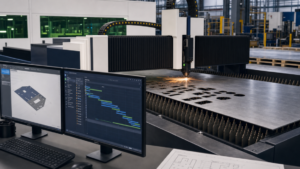
Laser and Press-Brake Software: Programming or Production Control?
Programming software fixes machine-ready work. Production-control software coordinates orders, materials, machine status, and work instructions. This guide helps sheet-metal fabricators choose the right scope—or connect both layers when the production problem crosses the shop.
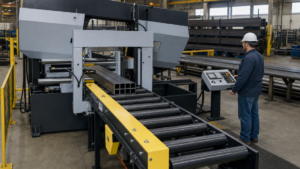
HYDMECH H-22A-120 for Long-Stock Structural Saw Modernization
The HYDMECH H-22A-120 is a sensible first modernization step when a structural saw loses more time repositioning long stock than cutting it. Its 10-foot bar feed, 120-inch indexing, job queue, bundling features, and optional conveyors address the saw cell directly, but downstream identification, drilling, coping, staging, and material flow still determine whether the upgrade creates capacity.
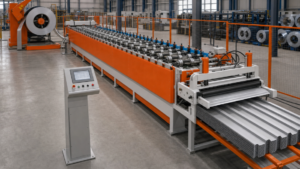
Stefa Roll Former Line Automation: What It Controls
The Mac-Tech-listed Stefa Roll Former Line automates stored-job production, encoder positioning, loop control, profiled cutoff, and pneumatic unloading for four roofing profiles. Physical profile setup, material qualification, inspection, and safe maintenance still depend on the production team.
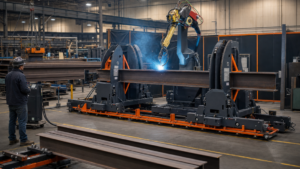
Can AGT BeamMaster Rotators Reduce Crane Moves?
AGT BeamMaster rotators can reduce repeated crane-supported flips and repositioning during structural-steel welding when compatible pre-fit members fit the cell envelope and the shop plans the remaining load-in, load-out, service, and exception work.
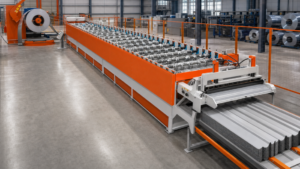
Stefa PFL Roll Former for Multi-Profile Roofing Panels
A Stefa PFL line makes sense when recurring roof, wall, facade, or architectural profiles justify a fixed coil-fed production path. The buying decision depends on matching the actual profile mix, coil range, cutoff method, discharge arrangement, and floor layout to the quoted configuration.
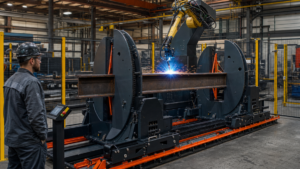
HII Robotics Agreements: What Robotic-Welding Buyers Should Prove
HII’s August 6, 2026 agreements show why robotic welding should be adopted through staged production proof. For fabricators considering an AGT BeamMaster, the decisive questions involve fit-up, data, weld quality, safety, ownership, material flow, and measured output—not the headline contract value.
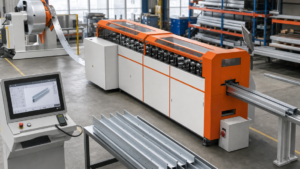
Stefa LSF Roll Former: Remote Support vs. Onsite Service
A connected Stefa LSF roll former can make CSV, alarm, and production-information problems easier to triage remotely. Material-path, forming, punching, cutoff, electrical-hardware, guarding, and safety-circuit conditions still require qualified onsite assessment.
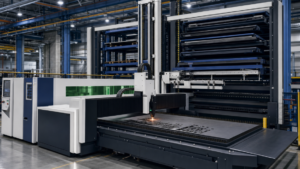
Shared Sheet Storage for Multiple Fiber Lasers
A shared HSG Store Pro tower can fit a high-mix shop with multiple fiber lasers when the machines share enough sheet inventory to justify one coordinated material path. The decision turns on sheet-envelope overlap, scheduling, remnant control, downstream flow, and recovery planning—not tower height alone.