
News
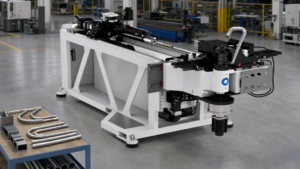
When Bidirectional CNC Tube Bending Fits High-Mix Parts
A fully electric right- and left-hand CNC tube bender fits high-mix shops when changing bend directions, radii, tooling, and part families make setup and reorientation a recurring production constraint. The decision still depends on representative-part testing and the exact machine configuration.
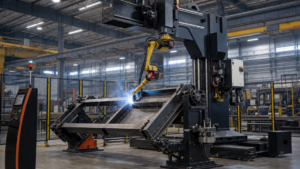
When Modular Robotic Welding Fits High-Mix Fabrication
AGT BLOK is a practical candidate for fabricators that repeatedly weld medium-to-large frames, skids, trailers, trusses, containers, and other complex assemblies in changing batches. The fit depends on recurring part families, consistent presentation, useful positioning, validated programming, safeguarding, training, and clear ownership after commissioning.
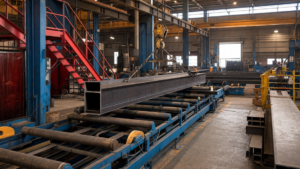
IMTS 2026: Evaluate Heavy Material Handling Before More Capacity
IMTS 2026 makes material flow part of the automation conversation. For heavy fabricators, the AMTEK material-handling offering provides a concrete option to evaluate before another processing machine adds capacity to an already congested route.
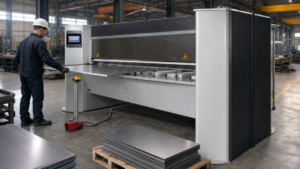
Hydraulic Plate Shear vs. Coil Processing
CMG’s new Omaha distribution facility makes sheet-to-part material flow worth revisiting, but the machine choice still depends on whether a shop needs batch blanking or continuous coil processing.
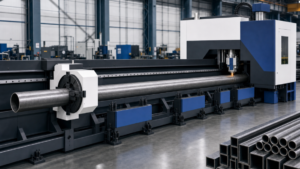
HSG U.S. Service Expansion: Preparing TS2 Support
HSG’s August 24, 2026 U.S. milestone creates a broader support context for TS2 tube-laser users, but it does not replace disciplined shop-side preparation. Machine identity, alarm evidence, job conditions, maintenance history, and safe access information still determine how useful the first support response can be.
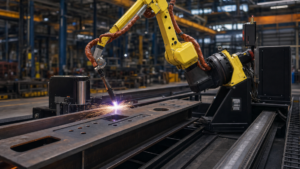
Weldall’s Waukesha Expansion: When Robotic Beam Processing Fits
Weldall’s August 2026 Bay 5 completion creates a timely capacity question for Upper Midwest structural shops: does beam-feature preparation justify robotic plasma processing, or is the real constraint saw capacity, material flow, or downstream welding?
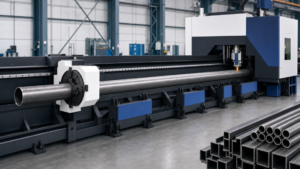
What ENCY 3.0 Changes for Tube-Laser Programming
ENCY 3.0 adds laser feature recognition, editable macros, a Digital Machine Center, sheet-or-stock nesting, and a beta CAM Agent. For an HSG TS2 V2.0, those capabilities still require machine-specific postprocessor, NC-code, simulation, profile, and sample-job validation before production use.
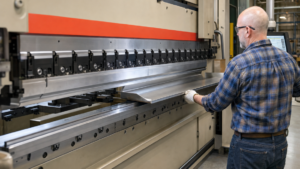
Wilson Tool Press-Brake Tooling: Retrofit or Replace?
Wilson Tool’s August 28, 2026 FABTECH announcement gives fabricators a timely way to separate three bending decisions: clamping for tool-change delays, crowning for deflection-related variation, and custom tooling for difficult geometry. The existing brake still has to meet the part’s force, envelope, and control requirements.
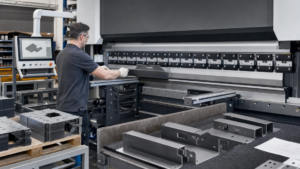
When a Hybrid Press Brake Fits a Fiber-Laser Workflow
A hybrid press brake can improve a fiber-laser cut-to-bend route when forming, repositioning, programming, or tooling changes create the measured queue. The RYTECH FUSION is a candidate for that constraint, but the quoted configuration and the rest of the workflow must be tested before a faster brake is expected to balance production.
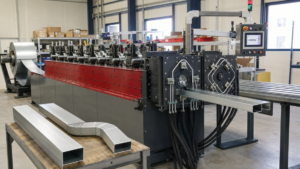
When a 3×4 Downspout Roll Former Fits
An integrated 3×4 downspout and elbow line fits when repeatable product demand makes separate forming, crimping, handling, or packing the larger constraint. This guide explains where the DOWNSPOUT ROLL FORMER 3X4 INCH fits, where a more flexible process remains practical, and what buyers should confirm before requesting a quotation.
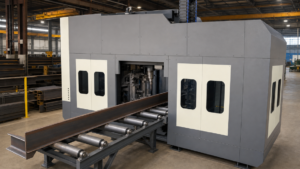
When a Structural Shop Needs CNC Beam Drilling
A CNC beam drilling machine fits when repeated hole-making, manual layout, and beam repositioning delay fitting or downstream work. The PBD BEAM DRILLING MACHINE adds multi-face drilling, secondary machining, automatic tooling capability, and CNC data input, but its value depends on the actual profile mix, detailing data, material flow, and acceptance requirements.
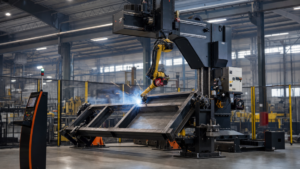
Should FANUC’s AI Welding Agent Delay Robotic Welding Capacity?
FANUC’s AI Welding Agent changes the software and upgrade questions around robotic welding, but it does not by itself remove the physical capacity, reach, positioning, workholding, and process-control reasons to evaluate an AGT BLOK system now.
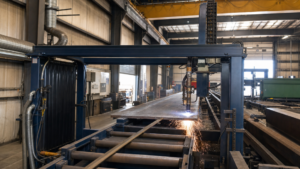
PRODEVCO PCR42 Capital Fit for Structural Steel
The PRODEVCO PCR42 fits a structural-steel capital plan when recurring beam and HSS work moves through several processing steps, reliable DSTV or NC1 data is available, and downstream capacity can use the output.
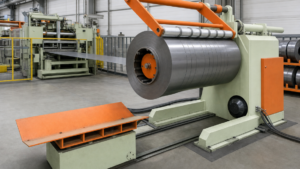
Recoiler or Cut-to-Length Stacker?
Choose a recoiler when slit material must remain in coil form for shipment, storage, roll forming, or another coil-fed process. Choose cut-to-length stacking when the finished product must be a flat blank, then confirm the STEFA EH1000 configuration against the actual coil, strip, speed, handling, and downstream requirements.
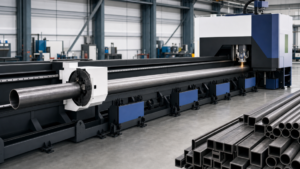
HSG TS2 V2.0 Wear-Item Inspection for Cut Quality
Inspect the cutting nozzle first when HSG TS2 V2.0 tube-laser cut quality changes, then evaluate the protective window and cutting-head interfaces according to the symptom. The installed head, nozzle specification, material, gas, and service history determine the correct replacement.