
News
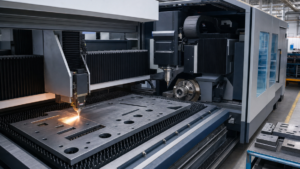
Muratec LS3015MC: Parts Planning for Integrated Laser Machining
Muratec’s announced LS3015MC North American debut brings fiber laser cutting and secondary machining into one platform. The practical consequence is a broader uptime plan covering laser consumables, machining tools, workholding, chip control, records, and service coordination.
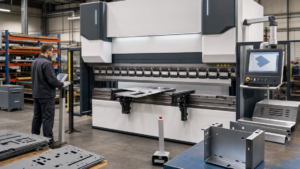
Ermaksan EVO-IV Press Brake for Laser-Cut Sheet Metal
The Ermaksan EVO-IV fits job shops that bend varied laser-cut blanks and need a configurable CNC press brake. Its servo-hybrid drive, broad length and tonnage range, six-axis machine configuration, motorized crowning, and optional control and measurement features can support variable cut-to-bend work, but the correct configuration still depends on part geometry, tooling, utilization, safeguards, and capacity.
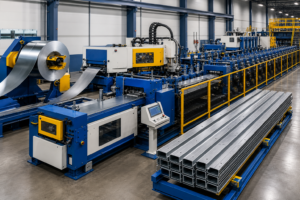
Pre-Punching vs. Post-Form Punching C/Z Purlins
Pre-punch the flat strip when the hole pattern is repeatable in the flat pattern and the coil, tooling, and feed envelope match the job. Punch after forming or use another operation when the feature depends on finished geometry or the product mix exceeds the selected configuration.
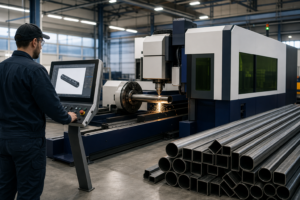
Used vs. New CNC Tube Lasers in 2026
Used CNC tube lasers can still deliver value in 2026 when proven capacity, safety, software, and support fit the work. Compare representative-part performance and ready-to-produce costs against new automation, profile handling, and bevel capabilities.
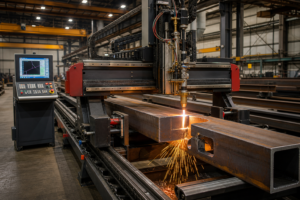
AMTEK APC 1200 Beam Coping: Plasma or Oxy-Fuel?
The AMTEK APC 1200 fits structural fabricators that need repeatable CNC coping, beveling, profiling, and related thermal cuts across beams and other structural profiles. Oxy-fuel remains the practical choice for thick sections and difficult access, while plasma can add throughput on thinner work only when the exact APC 1200 configuration, pierce limit, torch access, and cut-quality requirements are verified.
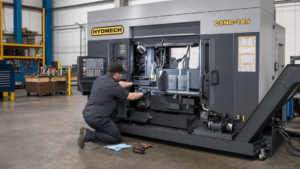
HYDMECH CSNC-125 Preventive Maintenance
The HYDMECH CSNC-125 automates lubrication, coolant-level alarming, feeding, chip removal, sorting, and production monitoring, but maintenance personnel still must verify delivery, inspect wear, manage fluid condition, review trends, and release the saw safely after applicable service work.
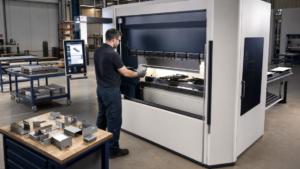
HSG HS1206 Press Brake for High-Mix Small Parts
The HSG HS1206 is a compact all-electric CNC press brake for small, changing part queues. It fits short-run brackets, covers, shallow boxes, channels, and enclosure components when manual flexibility matters more than the repeat volume needed for a panel bender or robotic press-brake cell.
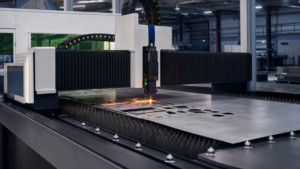
Higher-Power Laser, Second Laser, or Automation?
When a flat-sheet laser department is overloaded, the right investment depends on whether cutting time, available machine hours, or material handling is the constraint. Use the HSG G3015H and Store Pro 3015 as concrete options, then prove the choice with job-history and utilization data.
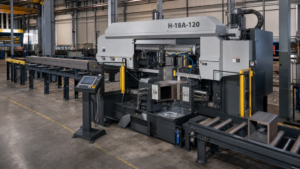
HYDMECH H-18A-120 for Legacy 90-Degree Cutting
The HYDMECH H-18A-120 is a practical first modernization step when repeated 90-degree cutting, manual indexing, and long-stock handling constrain a legacy cell. Its 10-foot bar feed, automatic indexing, hydraulic clamping, split front vise, stored jobs, and handling options improve the saw operation without replacing downstream drilling, coping, fit-up, welding, coating, or shipping processes.
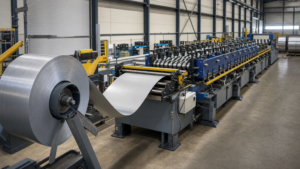
Can a Stefa Roll Former Make Short Roofing Panels?
The Stefa Roll Former Line has a published 100 mm minimum length, but reliable short-panel production still depends on profile geometry, cutoff behavior, material condition, end flare, and discharge handling.
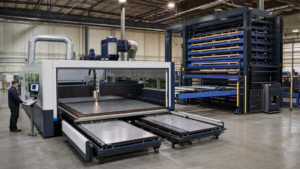
HSG G4020V 30 kW Laser for Large-Format Sheet Cutting
The HSG G4020V 6G 30 kW with STORE 4020 6 automation fits shops with recurring large-format sheet and plate work, but bed utilization, assist gas, tower limits, facility requirements, and downstream capacity matter more than the wattage alone.
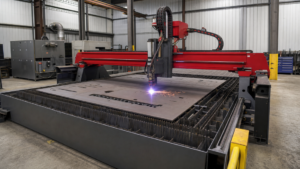
Sample Parts Must Prove the Akyapak Plasma Cutting Scope
A clean plasma-cut coupon is not enough to approve a heavy-fabrication project. Representative parts should prove the proposed Akyapak cutting scope, process repeatability, material flow, downstream fit, and installation interfaces before capital approval.
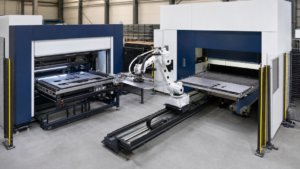
HSG ALG Wear-Item and Inspection Records: What to Document Before Requesting Parts or Service
Before asking for an HSG ALG replacement part or service support, build a record that identifies the installed automation system, captures the observed condition and alarm history, and separates a documented request from an assumed diagnosis.