
News
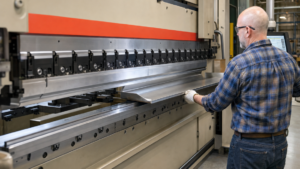
Wilson Tool Press-Brake Tooling: Retrofit or Replace?
Wilson Tool’s August 28, 2026 FABTECH announcement gives fabricators a timely way to separate three bending decisions: clamping for tool-change delays, crowning for deflection-related variation, and custom tooling for difficult geometry. The existing brake still has to meet the part’s force, envelope, and control requirements.
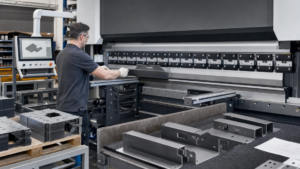
When a Hybrid Press Brake Fits a Fiber-Laser Workflow
A hybrid press brake can improve a fiber-laser cut-to-bend route when forming, repositioning, programming, or tooling changes create the measured queue. The RYTECH FUSION is a candidate for that constraint, but the quoted configuration and the rest of the workflow must be tested before a faster brake is expected to balance production.
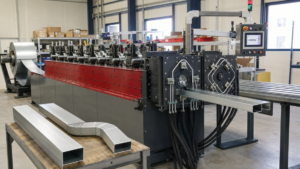
When a 3×4 Downspout Roll Former Fits
An integrated 3×4 downspout and elbow line fits when repeatable product demand makes separate forming, crimping, handling, or packing the larger constraint. This guide explains where the DOWNSPOUT ROLL FORMER 3X4 INCH fits, where a more flexible process remains practical, and what buyers should confirm before requesting a quotation.
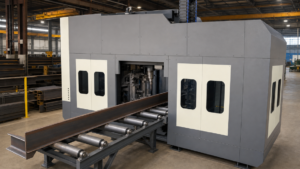
When a Structural Shop Needs CNC Beam Drilling
A CNC beam drilling machine fits when repeated hole-making, manual layout, and beam repositioning delay fitting or downstream work. The PBD BEAM DRILLING MACHINE adds multi-face drilling, secondary machining, automatic tooling capability, and CNC data input, but its value depends on the actual profile mix, detailing data, material flow, and acceptance requirements.
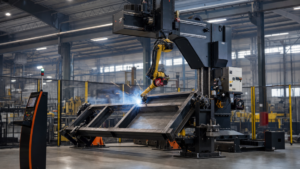
Should FANUC’s AI Welding Agent Delay Robotic Welding Capacity?
FANUC’s AI Welding Agent changes the software and upgrade questions around robotic welding, but it does not by itself remove the physical capacity, reach, positioning, workholding, and process-control reasons to evaluate an AGT BLOK system now.
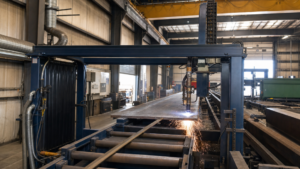
PRODEVCO PCR42 Capital Fit for Structural Steel
The PRODEVCO PCR42 fits a structural-steel capital plan when recurring beam and HSS work moves through several processing steps, reliable DSTV or NC1 data is available, and downstream capacity can use the output.
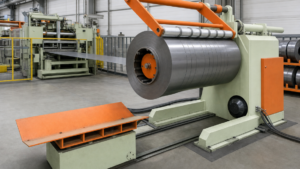
Recoiler or Cut-to-Length Stacker?
Choose a recoiler when slit material must remain in coil form for shipment, storage, roll forming, or another coil-fed process. Choose cut-to-length stacking when the finished product must be a flat blank, then confirm the STEFA EH1000 configuration against the actual coil, strip, speed, handling, and downstream requirements.
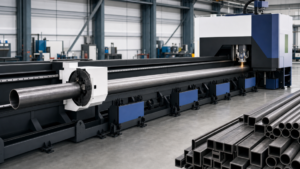
HSG TS2 V2.0 Wear-Item Inspection for Cut Quality
Inspect the cutting nozzle first when HSG TS2 V2.0 tube-laser cut quality changes, then evaluate the protective window and cutting-head interfaces according to the symptom. The installed head, nozzle specification, material, gas, and service history determine the correct replacement.
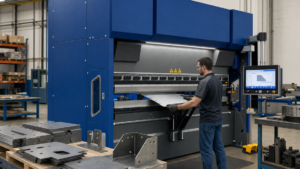
2026 Machinery Surge: When a New Press Brake Fits
The 2026 U.S. machinery-order surge is a capital-investment signal, not a reason to buy automatically. For laser-to-bending shops, the RYTECH FORCE ONE should be evaluated against actual queues, parts, tooling, programming, and handling constraints.
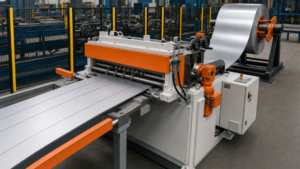
STEFA LCAS1.5 for Coil Slitting and Cut-to-Length
The STEFA LCAS1.5 combines coil entry, straightening, longitudinal slitting, and transverse shearing for thin-gauge sheet. It is a practical candidate for work needing both slit strips and flat blanks, but its final fit depends on coil data, blade setup, surface protection, output handling, and confirmation of the published capacity figures.
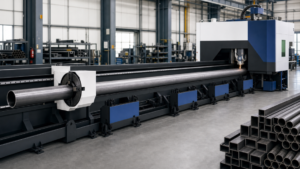
When a Used Tube Laser Needs a Retrofit
A used CNC tube laser is a capacity purchase only when it can run representative work safely and repeatably without rebuilding core systems. The HSG TS2 V2.0 provides a current benchmark for profile range, handling, controls, safety, and support.
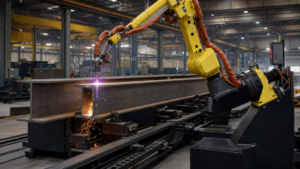
Accelerated Bridge Construction and Beam Processing
Accelerated bridge construction makes predictable beam processing more valuable, but it does not by itself make every structural fabricator a candidate for robotic plasma automation. The PRODEVCO PCR42 is worth evaluating when recurring plasma features, digital detailing, and manual coping or layout delays are the measurable constraint.
AISC 360 and 341 Drafts: What Structural Shops Should Review
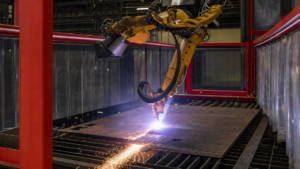
The AISC 360 and AISC 341 drafts do not require an immediate machine change. Structural shops should review contract requirements, approved detailing data, NC1 or DSTV release, measurement, marking, and inspection controls before changing production methods.
2026 Construction Rollforming Show: Fixed Roofing Roll-Forming Line Fit
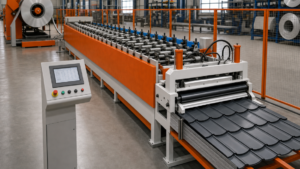
With the Construction Rollforming Show set for September 16–17, 2026, the STEFA ROLL FORMER LINE provides a concrete way to examine when fixed, multi-profile roofing production fits a plant—and what profile, coil, cutoff, handling, and site facts still need proof.
How Automatic Panel Bender Parts Work
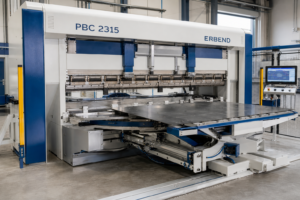
An automatic CNC panel bender keeps a flat sheet-metal blank horizontal while a blankholder, bending tools, manipulator, and CNC system form its flanges. That architecture suits many thin-gauge cabinets, enclosures, doors, architectural panels, furniture, and other box-shaped parts, but blank size, flange geometry, material, gripping area, and part mix still determine whether it fits better than a press brake or robotic bending cell.