
News
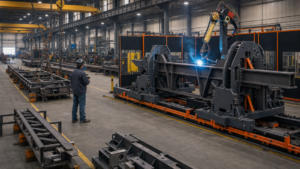
AGT BLOK Robotic Welding: Material Flow Before Arc Time
AGT BLOK can improve robotic welding productivity only when cut components, fit-up, fixtures, handling, access, and finished-part removal keep pace with the cell. The 1872 Factory One story shows why material flow should be designed before arc time becomes the headline metric.
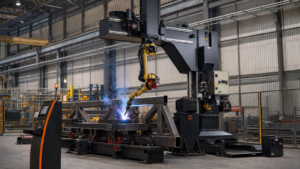
Physical AI and AGT BLOK Robotic Welding for Legacy Shops
Recent AWS coverage shows physical AI and adaptive welding moving into practical manufacturing discussions. For legacy structural and heavy-fabrication shops, the first step is usually narrower: stabilize one recurring weld bottleneck with a configurable robotic cell such as AGT BLOK, then add sensing or adaptive functions where variation has a measurable cost.
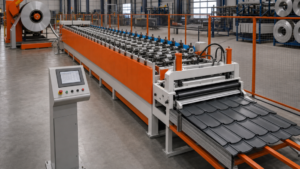
LUXR Metal Shingles: Fixed Roll-Forming Line Fit
The June 25, 2026 LUXR announcement creates a reason to evaluate new roofing work, but it does not prove that a four-profile fixed line can produce the new shingle geometry. The STEFA ROLL FORMER LINE has to be qualified against the profile, coil, cutoff, changeover, discharge, packaging, and repeat-volume requirements.
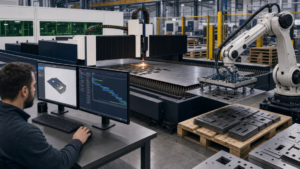
Lantek and TECOI Announce Robotic Sheet-Metal Palletizing
Lantek and TECOI announced a software-directed system that organizes cut parts by geometry and orientation, transfers them through an intermediate zone, and palletizes them while cutting continues. The development gives Indiana fabricators a practical way to evaluate the data, controls, layout, and handling conditions behind connected post-cut automation.
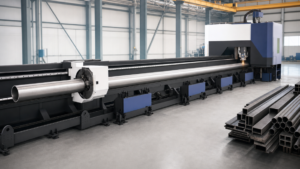
HSG TX3R Capital Fit for Large-Profile Fabrication
The HSG TX3R is a credible capital candidate when recurring large-profile work can keep its loading, clamping, and laser-cutting system productive. The investment is harder to justify when large profiles are occasional, the quoted configuration misses the required sizes or weights, or downstream departments cannot absorb the output.
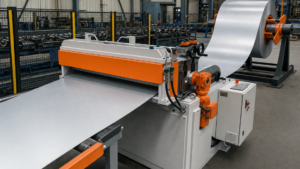
STEFA LA1.25 for Roofing Cut-to-Length Blanking
The STEFA LA1.25 fits roofing operations that need coil-fed straightening and repeatable flat blanks before forming, but it should not be treated as a complete roll former, leveler, or assumed slitting line.
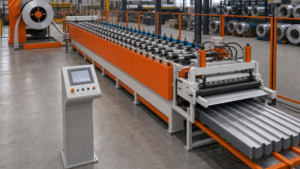
Multi-Profile Roofing Roll Former: Is It Right for Your Order Mix?
A four-profile roofing roll-forming line fits recurring, compatible panel work when the shop can group production and support the complete coil-to-cut-to-discharge flow. Dedicated equipment is usually stronger when one profile dominates, changes are frequent, or the material and geometry fall outside the documented envelope.
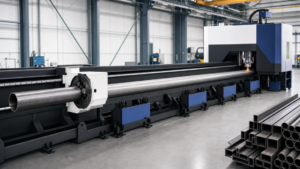
HSG TS2 V2.0 for High-Mix Tube Cutting
The HSG TS2 V2.0 is worth evaluating when short-run tube work includes holes, slots, contours, or selected bevel and weld-preparation features—not just straight cuts. This guide explains where 3D tube-laser processing can improve routing and where a saw, drill, flat-laser route, or outsourcing may still be the better fit.
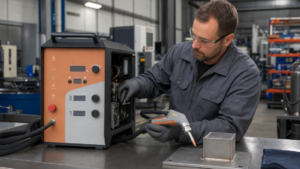
IPG LightWELD Preventive Maintenance
Consistent IPG LightWELD welding and cleaning results depend on optical care, consumable control, safety-function verification, useful records, and a clear boundary between routine maintenance and qualified service.
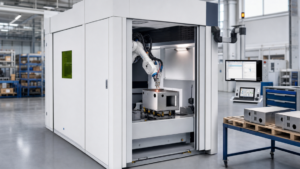
TRUMPF TruLaser Weld 3000 for High-Mix Welding
The TRUMPF TruLaser Weld 3000 is aimed at small-batch sheet-metal assemblies where compact robotic access, CAD-based programming, and repeatable fit-up can turn variable work into flexible laser-welding capacity.
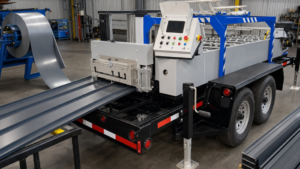
SSQ II Discontinuation: SSQ3 vs. SSQ II
The SSQ II MultiPro order window ends September 30, 2026. The SSQ3 keeps the 16-profile platform while changing tooling, controls, safety features, power options, and the practical buying decision for roofing and architectural-sheet-metal teams.
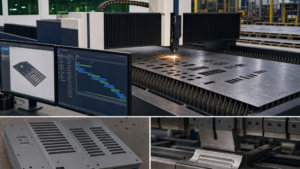
Laser-Cut Louvers and Embosses on a Press Brake
A CNC press brake with special forming tooling can produce selected louvers, embosses, clips, countersinks, and extruded holes in laser-cut blanks. The practical boundary depends on feature geometry, blank preparation, tooling, machine access, changeover, and production volume.
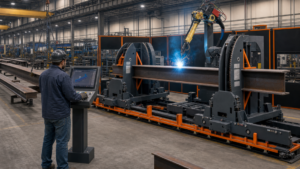
1872’s Autonomous Factory: Is Robotic Beam Welding the Next Step?
1872’s July 2026 factory announcement points toward software-orchestrated fabrication, but a focused robotic beam-welding cell is the more practical next step for shops with suitable structural-steel work, usable CAD data, and the operating discipline to support automation.
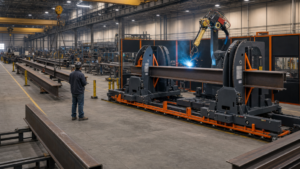
AGT BeamMaster Layout: Floor Space and Crane Access
An AGT BeamMaster cell needs more than its published machine envelope. The Light, Plus, or Twin configuration must be matched to the longest member’s handling route, crane coverage, safeguarded access, fit-up, inspection, and outfeed staging.