
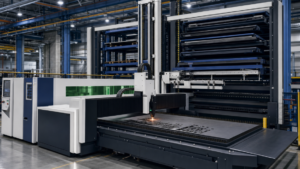
Shared Sheet Storage for Multiple Fiber Lasers
A shared HSG Store Pro tower can fit a high-mix shop with multiple fiber lasers when the machines share enough sheet inventory to justify one coordinated material path. The decision turns on sheet-envelope overlap, scheduling, remnant control, downstream flow, and recovery planning—not tower height alone.
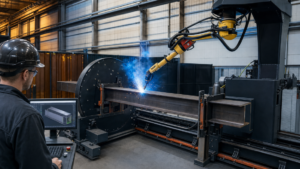
Robotic Beam Welding CAD Requirements for Structural Steel
The AGT Robotics BeamMaster is a practical fit for high-mix structural steel work when the shop can supply trustworthy model or weld-rule data, repeatable pre-fit assemblies, and a defined response to exceptions. CORTEX can generate robotic programs from 3D model data, while SnapCam 3D vision can measure loaded assemblies and offset paths for certain physical variation, but neither replaces model governance, fit-up control, welding procedures, or production ownership.
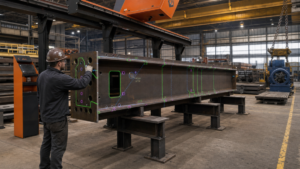
AGT LayoutMaster for Structural Steel Fitting
The AGT Robotics LayoutMaster projects 3D CAD fitting information onto beams, HSS, channels, angles, plates, and structural assemblies. It can reduce manual layout, but the application still depends on controlled CAD data, repeatable workpiece alignment, clear crane and operator access, and a material path that supports fitting through welding.
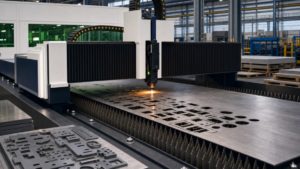
Small-Part Fiber Laser Cutting: Retention and Denesting
Small-part fiber-laser productivity depends on stable retention, clean release, and reliable sorting. The HSG G3015H should be evaluated as a complete nest-to-denesting process, not by laser power or cutting speed alone.
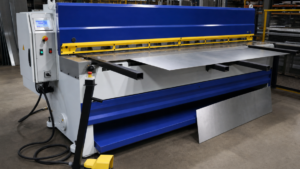
Mac-Shear MRGM 3060-04 for Straight Sheet Cutting
The Mac-Shear MRGM 3060-04 fits fabricators whose repeat work is mostly straight strips, rectangular blanks, and flat panels, provided the cut list stays within the machine’s listed 4 mm or 9-gauge steel rating and the 3060 mm or 10-foot model designation matches the actual sheet-handling plan. Its backgauge, squaring equipment, ball-transfer table, multi-edge blades, and optional controls support repeatable blank preparation, but geometry, alloy, handling, guarding, and downstream flow determine the final fit.
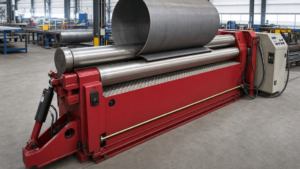
Akyapak AHV Service Preparation for Uneven Bends
Before requesting service for an Akyapak AHV, capture the machine configuration, serial number, material, target profile, active roll geometry, defect pattern, alarm evidence, recent changes, and safe photos. That information helps support personnel separate a forming-result problem from a setup question without encouraging unsafe troubleshooting.
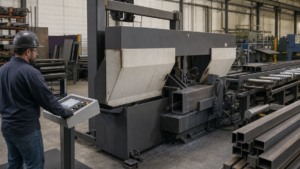
HYDMECH H-22A Automatic Band Saw for Structural Steel
The HYDMECH H-22A adds programmable 90-degree sawing capacity for structural steel, tubing, rounds, channels, angles, and heavy bar when the work fits its 22-inch envelope and the surrounding material flow can keep pace.
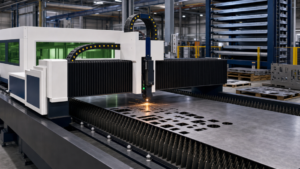
HSG Store Pro for Laser-to-Press-Brake Flow
HSG Store Pro 3015 can reduce laser-side material handling and improve cut-to-bend flow, but the finished-goods strategy must match press-brake scheduling, job identification, and downstream capacity.
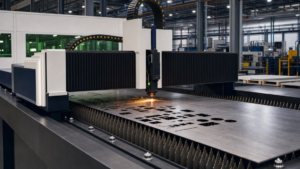
HSG G3015H: Alpha T Plus for Flat-Sheet Laser Cutting
The G3015H is most compelling when a shop needs 3015-format flat-sheet throughput and its real constraint is job preparation, nesting, or material flow rather than laser power alone. Alpha T Plus can strengthen that workflow, but the exact control version, power configuration, software boundary, and sample-part results still need to be verified.
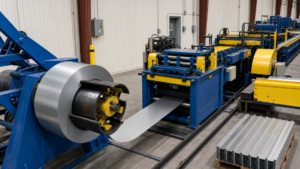
Tri County’s Onsite Roll-Forming Expansion: Portable vs. Plant
Tri County Metals’ August 10, 2026 rollout of a second onsite standing-seam roll-forming team makes the portable-versus-plant decision more practical for long-panel roofing work. Onsite production fits when panel length, access, or transit risk dominates; fixed lines remain stronger for repeatable, higher-volume production.
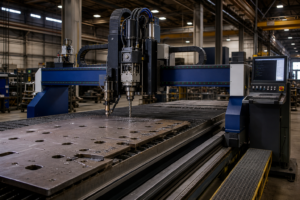
Messer Element 500 GD40 for Structural Plate Processing
The Messer Element 500 with GD40 is most relevant to structural shops whose bottleneck is cut-and-drilled plate work. It combines thermal cutting, drilling, tapping, countersinking, counterboring, beveling, and marking in one CNC setup, but it does not automatically replace equipment built around long beams, coping, or beam drilling.
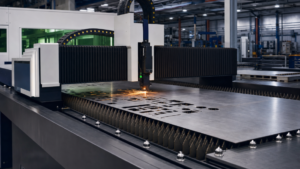
HSG X3015 Fiber Laser for Compact Sheet-Cutting Capacity
The HSG X3015 is worth evaluating as a second, satellite, or overflow 2D sheet laser when assigned work fits its compact sheet envelope and the plant can support the added output. Its portfolio value depends on floor layout, material mix, staffing, service, and downstream capacity—not laser power alone.
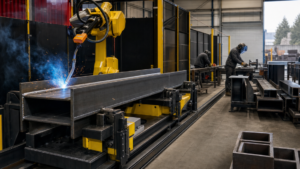
Robotic Welding Cell or More Welders for Structural Steel?
The AGT Robotics BeamMaster is a strong capital candidate when pre-fit structural assemblies, digital weld data, accessible joints, surface preparation, and sufficient volume are already controlled. When those conditions are missing, additional manual welding capacity, fitting improvements, or a staged automation plan may produce the better first result.
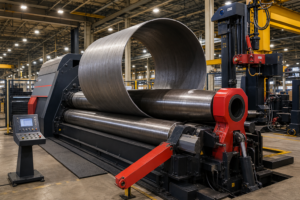
Davi’s Expanded North American Support for Plate-Roll Buyers
Davi’s expanded North American support operation can make application testing, training, parts planning, and retrofit review more practical for 4-roll plate-roll buyers, but it does not replace machine-fit validation.
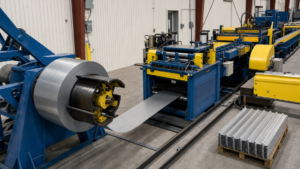
Bradbury’s 2026 Service Expansion and Coil-Line Support
Manufacturer service capacity belongs in the purchase decision for a coil-fed roll-forming line. Bradbury’s June 30, 2026 customer-service expansion provides a current example of why controls, tooling, training, diagnostics, and parts planning should be evaluated alongside the Stefa PFL’s coil handling, forming, cutting, and unloading requirements.