
News
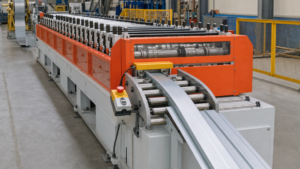
Fixed vs. Flying Cutoff for Roofing Roll Formers
Use the STEFA ROLL FORMER LINE as a fixed-shear reference to compare cutoff around panel length, profile tooling and receiving capacity—not nominal forming speed alone.
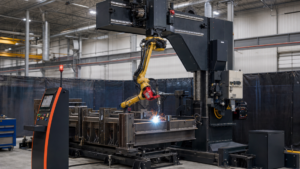
Metals Robot Orders Rise: BLOK Welding Expansion
Rising metals-sector robot orders put the focus on phased welding investment. AGT BLOK offers a common machine family with travel, positioning and programming matched to each plant’s assembly mix.
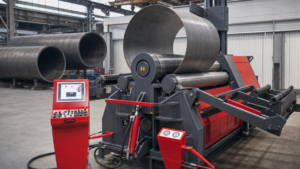
Akyapak AHV Plate Rolls for Thick-Plate Shells
The Akyapak AHV combines adjustable bending leverage with separate end-forming geometry. Evaluate thick-shell work against rolling and prebending capacity at the actual material strength, plate width and finished diameter.
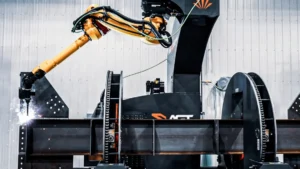
NIST MEP Awards and BeamMaster Investment
New MEP awards support automation assistance, not a published BeamMaster rebate. Evaluate the welding workload and complete cell investment.
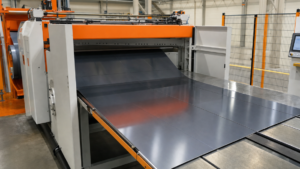
Protecting Prepainted Steel During Coil Slitting
Accurate dimensions do not guarantee an acceptable painted blank. The STEFA LCS2 illustrates how tooling, coated thickness, contact surfaces, protective film and blank removal influence rotary-slitting and cut-to-length equipment selection.
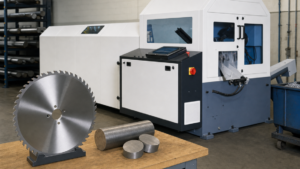
HYDMECH CSNC-65 Replacement Blade Selection
Select a CSNC-65 replacement blade by mounting dimensions, stock material, cutting conditions, and regrind eligibility—not diameter alone. Single-use tooling requires replacement; damaged blades must leave service before any recovery decision.
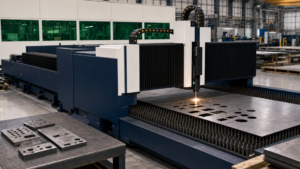
TRUMPF’s Planned Cutlite Acquisition and Large-Format Lasers
TRUMPF’s planned Cutlite acquisition would expand its large-format cutting portfolio. For oversized sheet and plate work, bed size, laser power, and loading capacity remain distinct decisions.
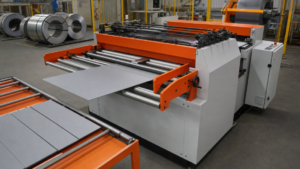
STEFA LCAS1.5 for Roofing Trim Blanks
The STEFA LCAS1.5 merits consideration for recurring rectangular roofing trim blanks needing both width and length cutting. Coil-width combinations, setup frequency, finish, and downstream flatness determine whether the coil route fits the work.
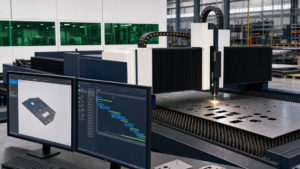
Used CO2 Laser vs. New HSG GH Fiber Laser
Choose between a used industrial CO2 sheet laser and a new HSG GH by usable cutting output, maintenance exposure, machine condition and installed purchase terms—not age or rated power alone.
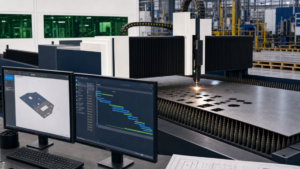
HSG GV Fiber Laser for Short-Contour Sheet Cutting
The HSG GV is worth evaluating when short contours and frequent direction changes constrain an older sheet laser. Compare its linear-motor platform, hydraulic exchange, and selected configuration on complete production nests at the required cut quality.
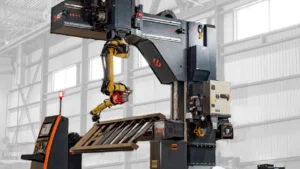
AGT BLOK Large-Weldment Robotic Welding
AGT BLOK fits large, variable weldments needing extended robot travel and configurable positioning. Evaluate usable welding capacity and the complete application under the revised R15.06 safety framework.
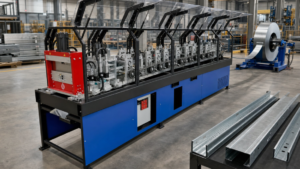
KFS 1220G3 Panelizing and Stud-and-Track Forming
The Scottsdale KFS 1220G3 supports single-coil panelizing members and conventional stud-and-track supply. Connection geometry, coil requirements and production sequence determine which mode fits the work.
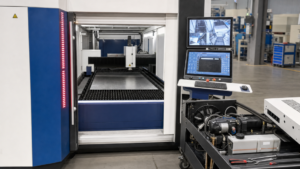
Fiber Lasers | Flat Lasers | Metal Fabrication Equipment | Parts & Service | Preventive Maintenance | Service
HSG G3015XPRO 20KW Chiller Maintenance
Maintain heat rejection, coolant circulation and condensation control on the HSG G3015XPRO 20KW. Lower coolant temperature is not automatically safer.
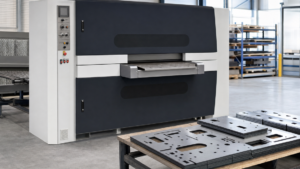
LISSMAC SBM-M B2 vs. Manual Oxide Removal
The LISSMAC SBM-M B2 is a candidate for recurring laser-cut steel edge preparation before coating. Compare suitable workload, demonstrated preparation time, installed expense, coating requirements, and future cutting plans.
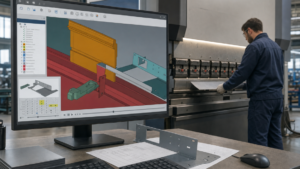
Lantek v46 Multi-Press-Brake Programming
Lantek v46’s announced Bend–MES integration can retain separate bending solutions for different CNC press brakes, supporting later machine allocation without assuming one program fits every brake.