
News
The Automation Cell That Cannot Be Serviced
A compact automation layout can preserve production flow on a drawing while making cleaning, fault recovery, component replacement, crane access, and safe service work impractical. Treat service tasks as layout inputs before fence lines, equipment locations, and handling interfaces are fixed.
Before Automating a Legacy Equipment Handoff, Design the Recovery Path
An automated handoff should improve material flow without turning a recoverable jam, inspection, or maintenance task into an extended shutdown of a productive legacy asset.
Laser Automation Scope Is Decided at the Nest
Available laser cutting time does not create usable output when sheets, completed nests, remnants, parts, and downstream queues do not move together. Scope load/unload automation around the actual handoff that is interrupting flow.
Where New and Used Equipment Interfaces Break Down in Automation Cells
Machine age is not the deciding factor in mixed-age automation. For Illinois and Iowa high-mix fabricators, the issue is whether a defined handoff has supportable controls, repeatable part presentation, safe recovery, and acceptance criteria.
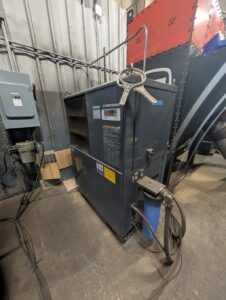
Feeder-Straightener-Cut-to-Length Interfaces: Define the Feed Sequence Before You Automate
Capable individual components do not create a coordinated coil line by themselves. Before approving automation, define material-state ownership, speed authority, permissives, fault recovery, safe access, and acceptance cases across payoff, straightening or leveling, feeding, cutoff, and downstream handling.
Plasma Cutting Capacity Is Decided at the Handoff
A plasma table creates usable capacity only when plate can be staged, cut, cleared, identified, ventilated, and delivered downstream without creating new queues. The approval decision belongs to the complete material flow, not table speed alone.
Press Brake Control Retrofit Approval Starts With the Programming Handoff
The right control retrofit improves the path from programming through setup and first-part approval. The wrong scope simply moves delay from the brake to the office.
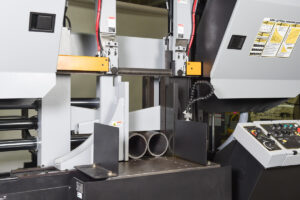
Replacing a Legacy Structural Saw Without Starving the Rest of the Shop
An automatic saw can be a practical first modernization step, but cutting capacity alone does not protect production. Review material flow, miter mix, downstream handoffs, and startup conditions before deciding whether a standalone saw is enough or conveyors belong in phase one.
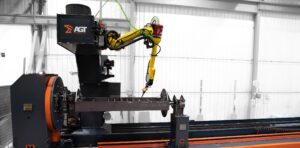
Robotic Welding Capital: Approve the Cell Only When Fit-Up Is Under Control
Robotic welding can expand capacity, but it cannot correct inconsistent parts, weak fixtures, material delays, or unclear ownership. The capital decision should begin with evidence that the upstream process is ready for automation.
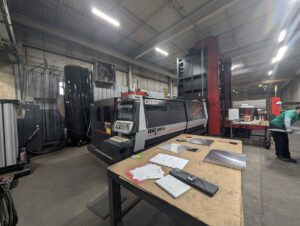
Amada ENSIS Automation Should Follow the Actual Bottleneck
High-mix fabricators should stage Amada ENSIS automation around the constraint that is actually limiting throughput. A standalone laser, AMS CL loader, AMS CLT tower, and TK-L parts sorter solve different material-flow problems and require different workload evidence.

Flat-Blank Shears and Flying Cutoffs Serve Different Material Paths
A hydraulic guillotine shear suits flat blanks headed to folding, bending, or staged fabrication. A profile-specific in-line cutoff belongs in a roll-forming line where formed panels must reach runout, stacking, and packaging without interrupting material flow.
HYDMECH Automatic Pivot Band Saws: Size the Saw at 30° Before Promising the Cut List
A section that fits at 90° may not fit at 30°. Compare the actual angled envelope, miter-positioning workflow, indexing, work load, and material flow before choosing a HYDMECH S-23A or M-20A.
AGT BeamMaster Utilization Should Not Depend on Unqualified Fill Work
An AGT BeamMaster investment should be supported by structural beam and column demand. Panels, skids, and short subassemblies can add utilization, but only when their fixtures, fit-up, access, handling, and material condition have been qualified separately.