
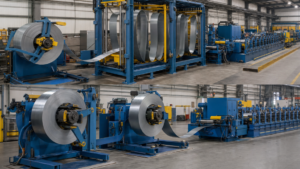
Strip Accumulator vs. Double-Mandrel Uncoiler
Choose a double-mandrel uncoiler to stage the next coil and reduce preparation and threading time. Consider a strip accumulator when the roll former needs to keep running while the incoming coil is changed and joined. The choice depends on which part of the changeover stops production.
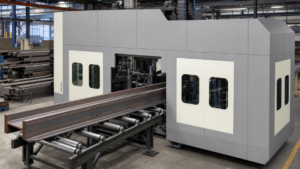
Prodevco PBD Beam Drilling for Structural Steel
The Prodevco PBD is a multi-spindle CNC beam-drilling family for recurring structural-profile work. Compare the documented PBD 7 and PBD 13 ranges against actual member drawings, hole patterns, tooling, file flow, and material handling.
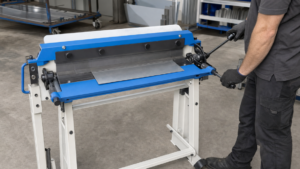
ERBEND UFA Manual Folder for Short Roofing Flashings
The ERBEND UFA may suit short roofing flashings and other simple folds when the selected model’s length and material capacity fit and a manual cycle meets the required pace. Here is how to assess its role beside a CNC folder.
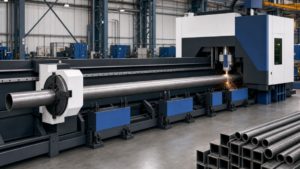
Buying a Tube Laser vs. Outsourcing Tube Cutting
Buying tube-laser capacity should follow recurring compatible work, not total supplier spending. Use the HSG TS2 V2.0 to compare ownership costs, released capacity, configuration fit, and the flexibility of outsourcing.
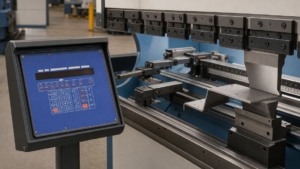
Automec CNC Backgauges for Multi-Bend Parts
Automec CNC backgauges organize successive gauge positions for recurring press-brake parts. The CNC 600 supports step images and job recall; compatible installed equipment determines whether ram depth and gauge height are also controlled.
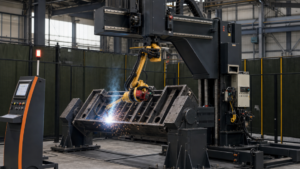
Adaptive Welding Retrofit vs. Robot Cell Replacement
A September 2026 operating report illustrates when adaptive controls merit evaluation—and when AGT BLOK’s travel, positioning and programming architecture addresses a different limitation.
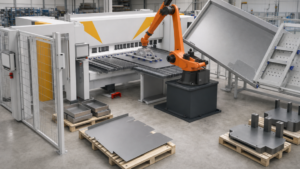
RAS XLTbend 2 with LUNA at EuroBLECH 2026
The XLTbend 2 with optional LUNA handling offers automated production alongside operator-guided folding. Its EuroBLECH preview highlights the geometry, gripping, and cycle questions behind mixed-batch panel automation.
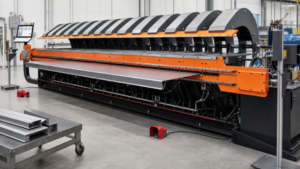
STEFA VHB Shear-and-Fold at METALCON 2026
STEFA’s METALCON 2026 announcement highlighted a compact VHB shear-and-fold format for roofing production. Its value depends on trim geometry, cutting requirements and batch capacity—not simply replacing two machines with one.
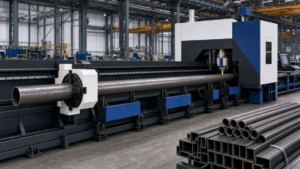
HSG TX3R Tube Laser Loading and Unloading
The HSG TX3R merits consideration when heavy-stock loading and finished-part removal are substantial production tasks. Match the proposed automation to stock limits, support through separation, collection needs, and operator responsibilities.
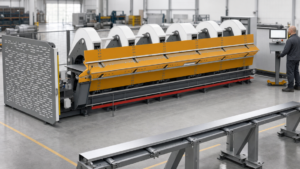
STEFA VHX Reverse-Bend Automation
The STEFA VHX can reduce turning of long profiles with opposing bends. Automatic production depends on whether each intermediate shape remains accessible to the positioning system and clears the tooling.
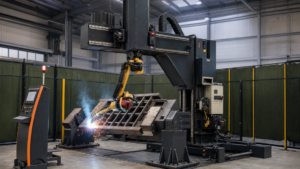
FANUC AI Welding Agent and BLOK CAD Programming
FANUC’s drawing-driven announcement gives AGT BLOK buyers a practical comparison: engineering inputs, joint coverage and remaining preparation—not an assumed cell upgrade.
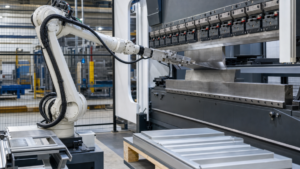
Robotic Press Brake ROI: A3’s New Training
A3’s September 16 robotics-course expansion adds business-case training. For robotic press-brake buyers, a useful ROI estimate must reflect achievable bending cycles, programming, changeover and the operator work that remains.
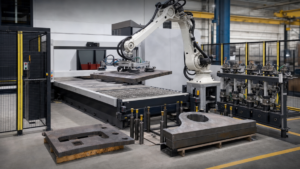
Teqram EasyGrinder Weld-Prep Expansion
EasyGrinder’s announced weld-preparation expansion could reduce intermediate heavy-plate transfers. Pallet supply, gripping, crane access and safe cell placement still determine the handling benefit.
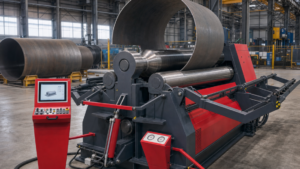
SweBend SURE Plate-Roll Measurement Preview
SweBend’s SURE preview adds edge and radius feedback during four-roll bending. Repeat shells and housings are useful evaluation jobs, but finished geometry, pre-bending capacity and package compatibility still determine fit.
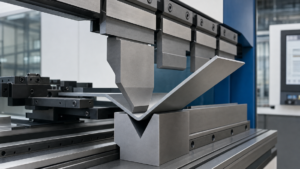
TRUMPF–Mate Deal: Press Brake Tooling Compatibility
The TRUMPF–Mate deal broadens supplier coverage, not tooling interchangeability. Existing holders, punch clearance and die selection still determine fit.