
I’m Adam Quoss, VP of Sales at Mac-Tech (aquoss@mac-tech.com), and I’ve watched too many Midwest shops “go live” on an integrated CNC cell only to spend the next 30 days firefighting. The fastest way to lose confidence is a weak handoff between OEM install, software integration, and shop-floor reality. The most common bottleneck I see is unvalidated changeovers and setup variability that turns an impressive demo cycle into real-world rework and downtime risk.
Why CNC Systems Fail at Handoff Quality, Uptime, Safety and Accountability
In the shop, commissioning fails when acceptance is based on a single demo part, not the mix of material, nesting, tool wear, and operator behavior that production sees every day. Responsibility gets blurry between machine builder, controls, offline programming, dust collection, material handling, and IT, so gaps hide until the first hot job hits. The fix is to turn handoff into a documented proof plan with named owners, measured thresholds, and a repeatable signoff path that eliminates “we thought it was included.”
Common failure points:
- Post processor not matched to real tool library, leading to incorrect feeds, pierce logic, or compensation
- Material handling and CNC not time-synced, causing idle time between load, clamp, probe, and cut
- Dust collection and air quality interlocks bypassed to keep running, increasing safety risk and downtime
- Incomplete parameter backups and restore process, making recovery slow after alarms or updates
Acceptance Criteria for Integrated CNC Environments What Must Be Proven Before Production
Acceptance criteria must prove the full system, not just the machine: CNC, offline programming, tooling, material flow, and operator workflow. I recommend setting pass fail targets for first-piece quality, repeatability across shifts, and controlled recovery from predictable faults. When Mac-Tech is involved in install and integration, we push to lock these criteria before equipment lands so everyone agrees on what “production-ready” means.
Your criteria should include measurable thresholds like CpK or tolerance bands on critical features, changeover time limits, and a minimum proven uptime percentage over a defined run window. Just as important, you need a documented “known-good” baseline for parameters, tool data, and network settings so you can restore in minutes, not hours.
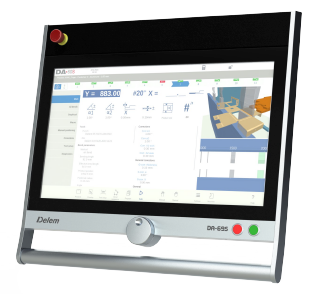
DELEM DA-69S
Delem DA-69S Press Brake Control
Advanced 3D Graphical Control for High-Precision Bending
Mac-Tech proudly offers the Delem…

MACHMOTION CNC CONTROLS
Validation Plan for Quality Cycle Time and Uptime Tests That Replicate Real Work
Validation needs to replicate real part families, not the easiest geometry, and it must include the ugly stuff: thick material, small features, frequent tool changes, and mixed nests. Run a structured test pack that includes first article inspection, in-process checks, and end-of-shift repeat runs so you can see drift from heat, wear, and operator variation. The practical fix is to write a commissioning router with defined lots, inspection points, and time stamps so cycle time and touchpoints are captured the same way every run.
Minimum test pack I use in commissioning:
- 3 part families across 2 thickness ranges with one mixed nest and one high-changeover job
- 2 shift repeatability run with tool wear allowed, measuring key features every X parts
- Fault injection tests: e-stop recovery, tool break detection response, power cycle restore
- Data capture: cycle time, non-cut time, alarms, scrap causes, and rework minutes per lot
A good target is to quantify cycle time variance within a tight band and prove a predictable changeover window, often saving 30 to 90 minutes per shift by removing “search time” and manual rework loops. If you’re also integrating quoting, scheduling, or nesting automation, confirming data handoffs and revision control avoids the silent killer: cutting the wrong rev at full speed. When it makes sense, we’ll align this to what your software stack can support, including automated reporting and job tracking from systems like Vayjo (https://vayjo.com/).
Safety and Training Readiness Verifying Interlocks Procedures and Operator Competency
Safety readiness is not a binder, it’s verified behavior under production pressure. Every interlock, light curtain, door switch, fume or dust system permissive, and safe stop must be tested and documented, including what happens after bypass attempts. The practical fix is to require a safety validation checklist plus a competency signoff for each role so you are not relying on one “super user” to keep the cell safe.
Training and safety readiness must prove:
- Interlocks function as designed and cannot be overridden without a recorded procedure
- Lockout tagout points are labeled and operators can demonstrate the sequence unprompted
- Alarm response playbooks exist for top 10 faults with clear escalation and downtime logging
- Operators can run a full changeover, verify program rev, and complete first-piece checks
In well-run commissioning, onboarding time drops because training is task-based and standardized, often cutting new-operator independence from weeks to days. When Mac-Tech supports training, we focus on the exact workflows your team will repeat daily: program load, tool verification, setup validation, and safe recovery. The outcome is fewer safety incidents, fewer “mystery alarms,” and more consistent quality across shifts.
Production Ready Signoff Framework Adam Quoss Commissioning Scorecards and Go Live Gates
Production-ready is a gate, not a feeling, and it should be earned with a scorecard that leadership and operators both trust. I use a simple go live framework: quality gate, cycle-time gate, uptime gate, safety gate, and training gate, each with objective evidence attached. If one gate fails, you do not declare victory, you run corrective actions and retest the failed portion only.
A strong scorecard forces decisions like whether to pause for a post update, lock parameters, add probing, or change tooling to stabilize first-pass yield. That discipline typically reduces scrap and rework immediately and prevents the slow bleed of 5 to 15 percent hidden downtime that comes from “workarounds becoming standard.” If you need a reference point for tooling, consumables, and cell accessories that affect repeatability, the Mac-Tech shop catalog is a practical starting place: https://shop.mac-tech.com/.
Next Steps for Modern Fabricators Scaling Commissioning Standards Across Cells and Plants
Scaling commissioning means turning your best cell’s proof plan into a template and reusing it across every install, retrofit, and relocation. Standardize your acceptance packets, job test libraries, parameter backup methods, and training matrices so performance is portable from plant to plant. The measurable outcome is faster ramp, fewer integration surprises, and predictable capacity planning because every cell is validated the same way.
If you are adding automation, connect the commissioning plan to your data trail: revision control, alarm analytics, and maintenance triggers. That makes uptime improvement continuous instead of reactive, and it shortens future upgrades because you already have baselines. For teams centralizing documentation and parts sourcing, keep your standards tied to what you can reliably procure and support, including spares and accessories through https://shop.mac-tech.com/.
FAQ
How fast can commissioning pay back in ROI?
Most shops see payback through reduced rework and fewer downtime events, often within the first 60 to 180 days depending on utilization and part mix.
How long should operator training take before go live?
Plan for role-based signoff over several short sessions, typically 1 to 3 days to reach safe independence plus follow-up after the first production week.
Should we retrofit an existing CNC cell or buy new?
Retrofits work when the mechanical platform is stable and the biggest gaps are controls, software workflow, or safety; new makes sense when repeatability and uptime are already limited by the base machine.
Will this acceptance approach work with our current CAD CAM and ERP stack?
Yes if you define data ownership, revision control, and post processor governance up front, then validate the full handoff from programming to the machine.
How do we avoid uptime risk during the first month?
Prove recovery steps with fault injection, lock a known-good backup, and require a top-10 alarm playbook so issues are resolved consistently across shifts.
If you want a commissioning scorecard and test pack that matches your part mix, email me at aquoss@mac-tech.com or reach out here: https://shop.mac-tech.com/contact/
Get Weekly Mac-Tech News & Updates
