
For U.S. metal roofing manufacturers in 2026, the real question is not which machine is faster. It is which workflow best supports your standing seam panels, trim, and flashing mix with the least labor exposure and the most predictable throughput.
Architectural demand remains steady, SKU counts are rising, and experienced brake operators are harder to find. Capital budgets are tighter and every investment must show operational clarity. When I work with owners and COOs, we frame the panel bender versus press brake discussion around total workflow impact, not machine class preference.
Process Fundamentals: Clamping and Folding vs. Punch and Die
Panel benders and press brakes achieve similar geometric outcomes through very different mechanics.
Panel benders from manufacturers such as Salvagnini and RAS use a clamping beam to hold the sheet while a folding beam moves up or down to create bends. OEM documentation positions these systems as highly automated, with integrated blank handling, automatic tool setup, and programmable bend sequences designed for repeat part families.
By contrast, a CNC press brake uses a punch and die set. The sheet is positioned against a backgauge, and the ram forms the bend into a die opening. Tool changes and setup adjustments are required as profiles vary. Modern CNC controls such as those from Delem support advanced offline programming, 2D and 3D simulation, and bend sequence validation, which significantly reduce trial and error compared to older brakes.
From a capital planning standpoint, this mechanical difference drives nearly every downstream implication in labor, setup, and material handling.
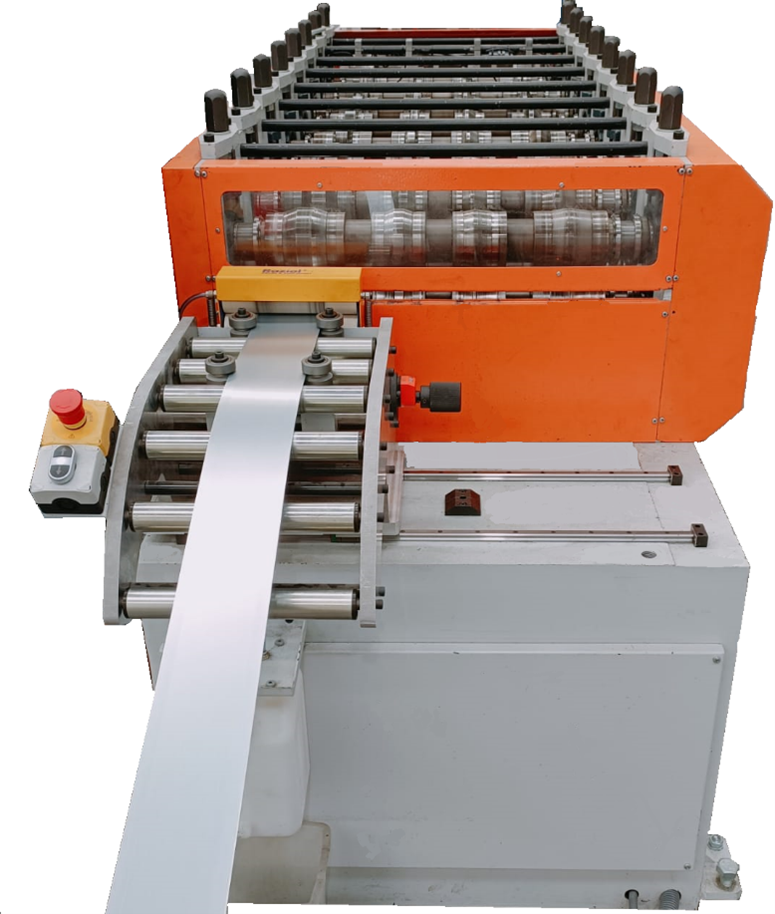
STEFA ROLL FORMER LINE

STEFA VHB SERIES LONG FOLDER
Labor Model and Operator Dependency
Trade analysis in The Fabricator highlights that panel benders are often positioned for reduced operator intervention on repeat parts, especially when paired with automated loading and unloading. Salvagnini and RAS describe configurations where part handling, tool setup, and bend sequencing are managed through CNC control and programmable tooling systems.
In practice, this can reduce reliance on highly skilled brake operators for repeat standing seam profiles and trim kits. However, automation level depends on configuration, part size, and how material is staged. A basic panel bender without automation still requires active handling.
A press brake, even with advanced Delem controls, remains more dependent on operator judgment, particularly for complex flashing with hems, offsets, and tight tolerance stacks. Skilled operators can adapt quickly to one off architectural details, but that flexibility comes with variability in setup time and training requirements.
When I evaluate labor risk with a CFO or plant manager, we look at two factors. How much of your volume is repeatable standing seam and trim. And how exposed are you to a small number of experienced brake operators. Panel benders can reduce that exposure in high repeat environments. Press brakes remain strong where flexibility outweighs automation.
Throughput Drivers: Setup, Batch Size, and SKU Volatility
The throughput conversation is often oversimplified. Speed per bend is rarely the bottleneck in roofing operations. Setup frequency and batch size sensitivity are usually the constraint.
Panel benders are designed around rapid changeover between programmed part families. OEM materials from Salvagnini emphasize automatic tool adjustment and batch processing logic. For high mix but repeat SKU environments such as standardized standing seam trims, this can compress setup time between runs.
Press brakes require physical tool changes and manual validation when profile geometry shifts significantly. Advanced CNC controls mitigate some of this through offline programming and stored job recall, but physical tooling still dictates changeover rhythm.
If your plant runs long batches of identical ridge caps or drip edges, both systems can perform well. If you switch constantly between custom architectural details, the flexibility of a press brake may offset its longer setup time.
Executives should map SKU frequency, not just total volume. A panel bender justifies capital more clearly when a defined percentage of work repeats predictably.
Material Handling and Long Panel Control
Standing seam panels and long trim pieces introduce handling challenges that go beyond forming force.
Panel bending systems from RAS and Salvagnini are designed with integrated grippers, support tables, and automated part rotation options. OEM positioning emphasizes reduced manual flipping and controlled panel movement during multi bend sequences.
On a press brake, long panels often require additional support arms, multiple operators, or custom staging to manage deflection and maintain consistency. Experienced teams manage this effectively, but labor content per part can increase with panel length.
For roofing manufacturers running longer architectural profiles, handling strategy directly impacts safety, scrap risk, and fatigue. When evaluating CapEx, consider not only bending time but also how many manual touches each panel requires before it leaves the cell.
Integration with Coil Processing and Laser Blanking
Many roofing operations are coil fed. CIDAN and Forstner coil processing systems illustrate how slitting and cut to length operations can be integrated upstream of folding equipment. In a coil first environment, line balance becomes critical.
A panel bender configured for batch processing can align well with pre cut blanks coming off a coil line, especially when part families are grouped and sequenced logically.
Press brakes also integrate effectively with coil fed blanks, but throughput synchronization depends more heavily on operator pacing and staging.
In mixed operations that combine laser blanking with forming, press brakes offer flexibility for structural crossover parts. If your roofing division shares laser capacity with other departments, the brake may align better with cross functional workflows.
The key question is not which machine integrates. It is which one stabilizes the entire line from coil or laser through finished profile without creating a new bottleneck.
Floor Space, Layout, and Safety Considerations
Panel benders typically require defined loading and unloading zones. Automated configurations may expand the footprint but can centralize handling within a contained cell.
Press brake cells are often more compact in base configuration. However, when you factor in staging tables, tool carts, and long panel support, the real footprint can grow.
From a safety perspective, reduced manual flipping and handling can lower strain risk in panel bending environments. That benefit depends on actual automation level and part size.
Before making a decision, walk your floor and sketch current and future layout scenarios. Capital planning should include forklift paths, coil staging, scrap flow, and expansion space.
Quality and Repeatability in Roofing Profiles
Architectural roofing demands consistent hems, offsets, and crisp corners.
Panel benders use controlled clamping and folding motions that OEMs position as repeatable across batches when programming is validated. For repeat standing seam components, this consistency can reduce rework.
Modern press brakes with advanced CNC controls and accurate tooling also achieve high repeatability, particularly when operators follow standardized setup procedures. Delem control capabilities support simulation and bend sequencing that reduce guesswork.
The practical difference emerges in high volume repeat work versus highly customized short runs. In repeat work, automation reduces variation. In custom work, skilled operators can adapt more fluidly.
A Capital Planning Framework for Roofing Executives
When I guide capital reviews, I use a simple framework.
Profile mix. What percentage of revenue comes from repeat standing seam and standardized trim versus custom architectural details.
Labor risk. How dependent are you on a limited number of highly skilled brake operators.
Setup frequency. How often do you change tooling or adjust setups across a typical shift.
Material flow. How many manual touches does each panel require from coil or blank to finished part.
Cross functional use. Will the equipment serve only roofing or also structural and general fabrication.
Service and training. Does your team have the appetite to support a more automated cell with integrated handling.
Panel benders tend to justify investment in high repeat, architectural profile environments where labor predictability and handling reduction matter most. Press brakes remain strategic in mixed shops where flexibility and crossover capacity are essential.
Practical Next Steps
Before allocating capital, gather real production data for at least one representative month. Track setup time per SKU, number of manual panel flips, rework incidents, and operator coverage gaps.
Map your coil or laser output against forming capacity to identify where imbalance occurs. In many cases, the bottleneck is not raw bending speed but changeover or handling.
Finally, evaluate growth strategy. If your plan involves expanding standardized architectural offerings, automation may align with that trajectory. If you are diversifying into broader fabrication, a flexible brake platform may carry more strategic value.
If you would like to review your current workflow, bottlenecks, and material flow before making a decision, I encourage you to use the contact form below. A structured evaluation often clarifies whether the right move is an automated panel bending cell, an upgraded CNC press brake, or a balanced combination of both.
Related Video
Mac-Tech | DELEM Profile T3D Offline Software
Sources
- https://www.salvagnini.com/en-us/panel-benders
- https://www.ras-online.com/en/machines/panel-bending
- https://us.cidanmachinery.com/forstner/
- https://www.thefabricator.com/thefabricator/article/bending/panel-benders-vs-press-brakes
- https://www.delem.com/
Get Weekly Mac-Tech News & Updates
