I’m Adam Quoss, VP of Sales at Mac-Tech (aquoss@mac-tech.com), and most of what I do is walk Midwest structural shops, watch parts move, and then map where time and labor are actually disappearing between cut, drill, mark, cope, and ship. The biggest bottleneck I see in the real world is handoffs: every time a beam leaves the saw, gets staged, reloaded, re-zeroed, and re-verified downstream, you add queue time, operator variability, and rework risk. When volume climbs or labor gets tight, those hidden minutes become the difference between staying ahead of the schedule and running weekends to catch up.
When Saw Plus Drill Lines Become a Throughput and Labor Bottleneck
A saw feeding a drill line can look efficient on paper, but in many shops the constraint is not cutting or drilling, it is the space and labor between them. If the saw is batching by length while the drill line is batching by W-shape, you create constant micro-changeovers and WIP piles that eat floor space and attention. That mismatch typically shows up as a full staging area, an operator waiting on a forklift, and a downstream machine starved or blocked.
Common failure points:
- Saw outputs mixed priority parts that don’t match drill queue sequence, forcing resorting and double handling
- Manual material ID or hand-marking after cut, leading to wrong part orientation at the drill
- Re-zero and probing on every load because cut squareness or datum is inconsistent
- Changeovers driven by “what’s on the floor” instead of a controlled run plan
The practical fix is to treat the saw plus drill line as a single scheduled cell: lock a run plan by profile, standardize datum strategy, and enforce digital part ID at the saw so the drill receives an unambiguous orientation. When shops do that, I commonly see one full material touch eliminated per part and changeover time drop by 10 to 20 minutes per batch, which compounds fast across a week.
What Hydmech Plus Downstream Ops Really Costs in Touches, Staging, and Rework
Hydmech saws are strong production assets, but the real cost shows up in downstream ops when the saw is effectively a “cut-only island.” Each downstream step introduces additional touches: offload, stage, re-pick, load, clamp, locate, verify, and only then process. Even if each touch is only a minute or two, multiply that by hundreds of members per shift and you are budgeting labor to move steel instead of value-added work.
A practical workflow improvement is to reduce variability at the saw and digitize the handoff: consistent cut quality, fixed reference rules, and barcode-driven part tracking that follows the member through drilling and marking. Where Mac-Tech typically helps is aligning installation realities like infeed/outfeed conveyor geometry, part ID method, and operator training so the saw output is repeatable enough to trust downstream automation without constant “operator save” adjustments. The measurable outcome is fewer wrong-holes and mislocated features, plus a cleaner queue that shortens lead time by hours, not minutes, on multi-job days.
For shops looking to tighten quoting and scheduling, capturing actual cycle and handling time by operation is also a game changer; it turns “we think the drill is the bottleneck” into a hard number you can staff and schedule around. If you want a reference point for tooling and consumables planning that impacts changeovers and uptime, you can start here: https://shop.mac-tech.com/.
Where Integrated Beam and Plate Systems Win on Flow, Utilization, and Labor Reduction
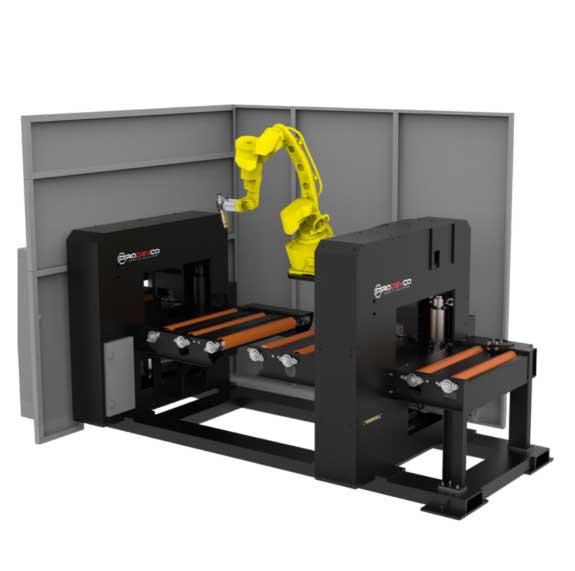
Integrated beam and plate systems in the Prodevco or Akyapak style win when your goal is fewer human decisions per part. The key advantage is continuous flow: the system controls measuring, locating, drilling, marking, coping, and discharge in a coordinated sequence so the member is referenced once and processed to completion with minimal interruption. In shops that are labor-constrained, that single-reference concept is often worth more than raw spindle horsepower.
Where integration pays back fastest:
- Single datum capture reduces rework from flipped members and incorrect end referencing
- Automatic part ID and run sequencing reduces sorter labor and staging space
- Tool management (drill, scribe, mill) cuts changeovers and improves repeatability
- Unified programming reduces “tribal knowledge” and speeds onboarding for new operators
The practical step is to unify the data path: one program source feeding both beam and plate operations, with consistent part definitions and an error-proofed orientation rule set. Done right, you can often redeploy one operator per shift from handling and setup into fit-up or weld prep, and you see scrap and rework drop because features are produced from a controlled coordinate system instead of multiple manual re-establishments.

2002 HYD-MECH S-20 SERIES II BAND SAW
- Year: 2002
- Power: 3hp
- Blade Width: 1″
- Blade Thickness: 0.35″
- Blade Length: 162″
- Dimensions: 93x86x52
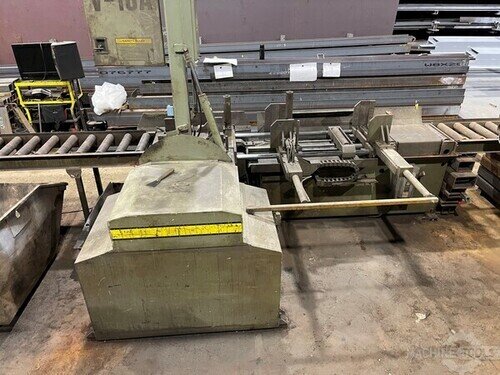
HYDMECH V-18A
Decision Framework for Choosing Saw Plus Drill Line vs Integrated Beam Processing
If your mix is mostly straight cuts with intermittent drilling, a saw plus drill line can be the right answer, but only if you can keep the line fed without staging chaos. If your work includes frequent hole patterns, coping, marking, and mixed member sizes with high changeover frequency, an integrated system usually delivers a better labor model because it compresses multiple steps into one controlled flow. The question I ask first is simple: how many times does a part get touched between raw stock and kitted-to-weld, and how many of those touches add value?
A practical decision framework is to score your current state in four numbers: touches per member, average changeover minutes per batch, rework rate (holes or cope corrections), and operators per processed ton. If you are over 3 to 4 touches per member and changeovers are consuming more than an hour per shift across the cell, integration tends to pencil out quickly because you are buying labor stability and schedule reliability, not just faster drilling. When we support evaluations at Mac-Tech, the most useful outcome is a layout and workflow plan that reflects real forklift paths, staging limits, and training needs rather than brochure-rate throughput.
Next Steps for Modern Fabricators Building a Scalable Structural Processing Cell
Start by mapping the cell as it runs today, including off-machine time, because that is where most throughput claims live or die. Then define a standard: one run plan, one datum rule set, one part ID method, and one programming workflow that the whole team follows. Those basics often cut onboarding time from weeks to days because the process becomes repeatable instead of personality-driven.
From there, decide whether your next constraint is machine cycle time or material movement. If it is movement, prioritize integration steps such as automated discharge sorting, barcode tracking, or combining operations into one pass. For shops wanting to standardize tooling, spare parts, and operator resources as they scale, it helps to centralize purchasing and spec control; a good starting point for common items is https://shop.mac-tech.com/.
FAQ
What ROI window is realistic for moving from a saw plus drill line to an integrated beam system?
Many shops target 18 to 36 months, driven mostly by labor reduction, fewer touchpoints, and lower rework rather than pure cycle-time gains.
How long does training typically take for operators on integrated beam and plate systems?
Expect days to get producing and a few weeks to get fully efficient, especially if you standardize programming inputs and part orientation rules.
Can I retrofit improvements to my existing Hydmech plus downstream setup instead of buying an integrated system?
Yes, upgrades like part ID, run-plan discipline, datum standardization, and better infeed/outfeed staging often recover meaningful hours before you replace equipment.
How do integrated systems handle compatibility with common detailing and CNC file workflows?
Most modern systems support standard structural file formats and can be aligned to a single source of truth so parts stay consistent from detailing through processing.
What is the biggest uptime risk when integrating multiple operations into one machine?
The risk is concentrating dependency, so preventive maintenance, tool management, and having a clear bypass or contingency plan become more important than ever.
If you want to walk through your mix and build a throughput and labor model around your actual touches, email me at aquoss@mac-tech.com or reach out here: https://shop.mac-tech.com/contact/.
Get Weekly Mac-Tech News & Updates

Similar Posts
Mastering Precision: Prodevco’s Automated Plate Processing
Adam Quoss, VP of Sales at Mac-Tech, explores Prodevco’s automated plate processing in Mastering Precision. He offers actionable insights for decision-makers aiming to modernize fabrication operations. Emphasizing hands-on experience, Quoss highlights the benefits of automation for enhancing efficiency and precision, positioning it as essential for staying competitive in today’s market.
Phased Upgrades to Integrated Cells, Lower Risk
Learn how phased upgrades to integrated cells cut risk, modernize fabrication, and boost ROI with practical steps from Mac-Tech VP Adam Quoss.
Unlocking Automation with Ermaksan: Insights for Lean Production
Adam Quoss, VP of Sales at Mac-Tech, offers a hands-on perspective on leveraging Ermaksan technology to enhance lean production. He provides practical guidance for decision-makers aiming to modernize fabrication operations, emphasizing how automation can streamline processes, reduce waste, and boost efficiency in today’s competitive manufacturing landscape.
Hydraulic vs Hybrid vs Electric Press Brakes in High-Mix
Compare hydraulic, hybrid, and electric press brakes for high-mix shops—modernization tradeoffs, performance, and ROI insights for leaders.
CNC Control Upgrade vs New Machine Payback Signals
CNC control upgrade or new machine? Adam Quoss shares payback signals, modernization impacts, and ROI cues to guide fab leaders.
Prodevco Automation vs. Traditional: Unveiling ROI Gains
Adam Quoss, VP of Sales at Mac-Tech, explores the ROI benefits of Prodevco Automation compared to traditional methods. His hands-on analysis offers decision-makers practical guidance for modernizing fabrication operations, emphasizing efficiency and cost-effectiveness. Quoss highlights how strategic automation investments can significantly enhance productivity and profitability in the fabrication industry.