
Wind Tower Fabrication: Ermaksan High-Tonnage Press Brakes Section 179 Expensing
As President of Mac-Tech, I help fabricators plan investments that convert market momentum into durable profitability. Wind tower production is one of those rare opportunities where capacity, precision, and uptime translate directly into booked backlog and higher margins. The right high-tonnage press brake is not just a machine purchase. It is an operational strategy that strengthens your floor while Section 179 gives real relief on the balance sheet in the same tax year.
Converting Wind Tower Demand into Competitive Advantage with High-Tonnage Bending Capacity
Wind tower demand rewards shops that can bend thick plate accurately, repeatedly, and safely at scale. When schedules are tight and steel is expensive, every fraction of a degree matters. A high-tonnage press brake reduces rework, eliminates stop-start bottlenecks, and stabilizes your production plan so downstream rolling and welding stay on tempo.
The competitive advantage shows up in three places. First, predictable takt times that let you book work with confidence. Second, reduced consumable and scrap cost that protects margins when prices move. Third, a safer, more automated bend cell that makes it easier to staff second shifts and cross-train operators without sacrificing quality. Capacity plus control beats raw tonnage every day.
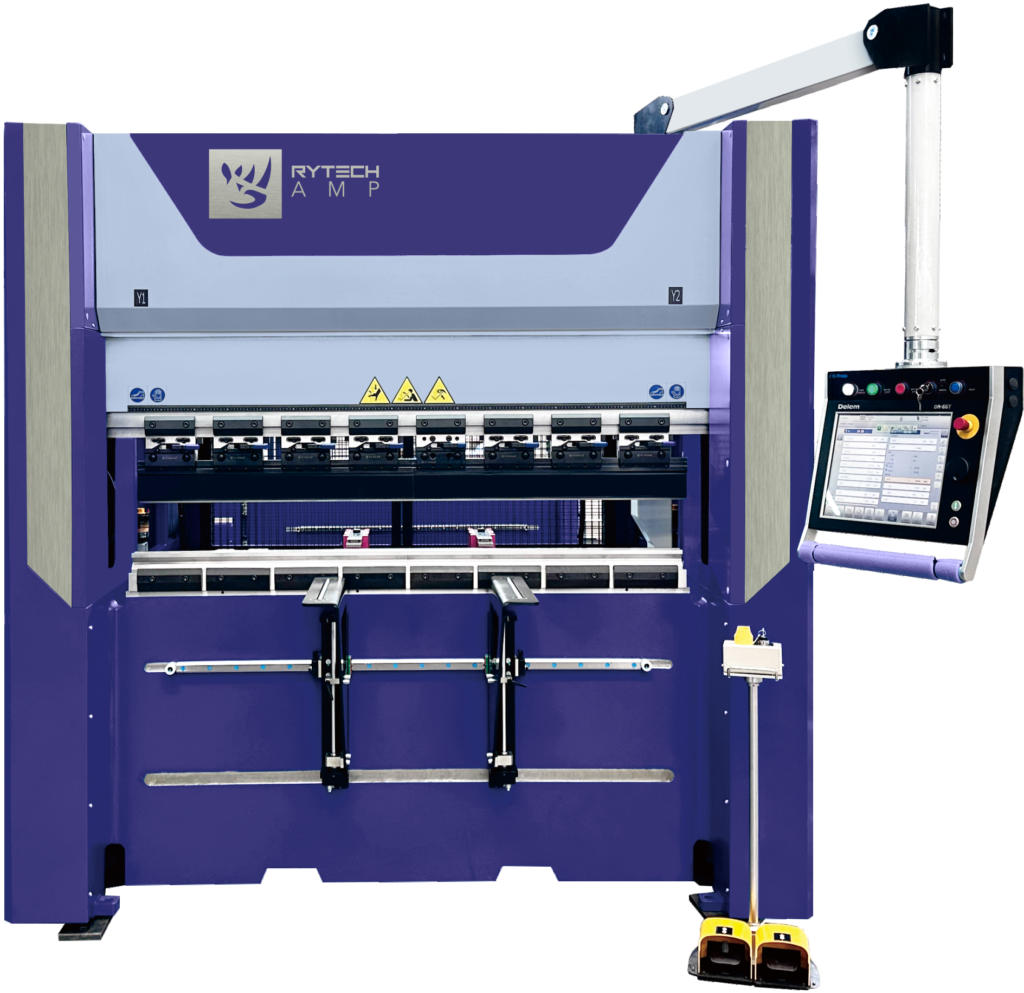
RYTECH AMP SERVO-ELECTRIC PRESS BRAKE

ERMAK EVOIII 3760-175
- Ermak EvoIII 3760-175 (193 Ton x 12’)
- 7-Axis: Y1, Y2, X, R, Z1, Z2, X-Prime (+/-3.94”)
- Delem 66Touch CNC Control, 17”
- CNC Motorized Crowning
- Precision Tooling Package
Ermaksan High-Tonnage Press Brakes for Tower Sections: Precision, automation, and uptime that scale
Ermaksan builds high-tonnage, long-bed press brakes specifically suited to heavy plate for towers, flanges, door frames, and internal structures. Configurations scale from single large-frame brakes to synchronized tandem systems that deliver multi-thousand ton capacity and long bending lengths. The frames are stress relieved and finite element engineered to resist deflection under sustained load, which is vital when you are bending thick plate all day.
For control, Ermaksan integrates advanced CNC controls such as Delem touch-screen platforms with 3D offline programming, CNC dynamic crowning, multi-axis backgauges, and hydraulic or servo-hydraulic systems for precise ram positioning. Options like front sheet followers, heavy-duty front supports, hydraulic tool clamping compatible with common tooling standards, and laser-based angle measurement shorten setup and maintain first-pass accuracy. Safety systems such as light curtains or laser guarding and robust guarding packages help operators work efficiently while maintaining compliance.
Uptime comes from straightforward hydraulic architecture, quality components, and serviceable designs. Remote diagnostics, accessible filters and valves, and parts availability keep the machine running when your tower schedule is under pressure. Mac-Tech stocks critical spares and supports preventive maintenance to protect this uptime advantage.
Section 179 Expensing and Bonus Depreciation: Pull forward ROI and de-risk CapEx in the current tax year
Section 179 allows many fabricators to expense the full purchase price of qualifying equipment placed in service by year end, subject to annual limits and phase-outs. For a high-tonnage press brake, that means you can convert a capital purchase into a current year deduction, reducing taxable income now rather than depreciating slowly over time. Bonus depreciation may apply to amounts above Section 179 limits, with percentage rates set by the current tax year.
Consider a simplified illustration. A multimillion dollar brake placed in service this year can generate a large deduction under Section 179 and any applicable bonus depreciation. At a combined tax rate that includes federal and state, the cash tax savings can offset a meaningful portion of your down payment or early lease installments. You still need to confirm eligibility, current limits, and state conformity with your tax advisor, but the principle is clear. Pulling forward deductions de-risks the investment and accelerates payback.
Mac-Tech coordinates lead times, commissioning schedules, and documentation so your equipment is installed, tested, and in service within the window your tax team specifies. We work with your CPA or CFO to provide invoices, acceptance certificates, and placed-in-service attestations that make the tax filing clean.
Quantified ROI Levers: Setup reduction, plate handling efficiency, first-pass yield, and labor redeployment
Setup reduction is the fastest win. CNC hydraulic clamping and offline programming typically cut tooling changeover and program prove-out by 30 to 60 percent compared to manual setups. If you run two to three changeovers per shift, that can free multiple hours per day for value-added bending. On a fully burdened labor rate, those recovered hours often fund a significant share of the monthly finance payment.
Plate handling efficiency improves when front sheet followers and heavy supports carry the load on large plates. Operators reposition less, spot fewer helpers, and keep the neutral axis aligned. Many shops report one to two fewer touches per part and noticeably lower ergonomic strain. On thick tower plate, fewer touches also mean fewer surface marks and less downstream cleanup.
First-pass yield rises with CNC crowning and in-process angle verification. Moving from manual gauging and iterative rebends to controlled feedback can lift first-pass yield into the mid to high nineties. Each avoided rebend saves minutes, reduces risk of microcracking on heavy plate, and prevents schedule ripple effects. Combined with lower scrap, these quality gains add up.
Finally, labor redeployment matters. When a high-tonnage cell runs with two operators instead of three, or a second shift does not require your A-team to maintain accuracy, you unlock capacity for rolling, fit-up, and weld. Spreading skilled labor across more throughput is often the decisive ROI lever in tight labor markets.
Integration Roadmap: Tie press brakes to plate rolling, weld prep, and digital QC for end-to-end throughput
A wind tower line moves from plate prep to pre-bend to rolling to tack and submerged arc weld. The press brake can be the pacing asset for the upstream side if it is digitally connected. With offline programming and shared models, bend allowances and developed lengths stay aligned with the plate roll programs. That means your pre-bend geometry matches the rolling plan and fit-up times drop.
Mac-Tech helps integrate the press brake control with nesting and CAM for consistent bend data, and with MES and ERP for job dispatch and part traceability. We can enable barcode or QR-driven program calls at the brake, capture bend angle measurements for digital quality records, and push production counts upstream to material requisition. For weld prep, we coordinate beveling parameters and flange flatness criteria so downstream automated welding cells see less variation.
If you are building cones and cans with tight tolerances, we recommend a metrology loop that includes portable arm scanning or laser trackers tied to the brake and roll data set. When nonconformance shows up, you want to adjust the bend recipe quickly and document the corrective action. That is how you keep end-to-end throughput stable while volume ramps.
The Mac-Tech Advantage: Financing, turnkey commissioning, operator training, and lifecycle performance support
Buying a high-tonnage press brake is a strategic move. Mac-Tech pairs Ermaksan machines with financing options that include equipment loans and $1 buyout leases to match your cash flow and tax plan. We model after-tax cash flows with your team, coordinating Section 179 and bonus depreciation assumptions so the financing structure supports the ROI you expect.
Our turnkey project delivery includes floor layout, electrical and hydraulic readiness, rigging, level and anchor, and full runoff. Operators and programmers receive hands-on training that covers tooling selection, thick plate best practices, crowning strategies, and safety protocols. We also train maintenance teams on preventive routines to protect long-term accuracy.
After commissioning, lifecycle support keeps the brake producing. We offer preventive maintenance contracts, remote diagnostics, priority parts stocking, and guaranteed response times. When you decide to expand with tandem configurations or additional automation, we design the roadmap so your investment appreciates over time, not the day it hits the floor.
You can reach me directly at joe@mac-tech.com or 414-477-8772. If you are evaluating high-tonnage bending for wind towers, I will help you build the business case, select the right configuration, and place it in service on your timetable.
FAQ
What distinguishes Ermaksan high-tonnage brakes for wind tower work compared to standard brakes?
Heavier frames, longer beds, synchronized tandem options, and thick-plate features such as CNC crowning, multi-axis gauging, and sheet followers enable accurate, repeatable bends on large, heavy sections while maintaining uptime.
Can Section 179 fully expense a large press brake in the current year?
Often yes, subject to annual limits, phase-out thresholds, and placed-in-service requirements. Bonus depreciation may apply to the remainder. Always confirm current-year rules and state conformity with your tax advisor.
How do you align a new press brake with existing plate rolls and weld cells?
We connect controls and CAM so bend allowances and programs are consistent, implement barcode-driven program calls, and capture measurement data for digital QC. This reduces fit-up time and stabilizes throughput.
What is a realistic timeline from purchase order to parts off the machine?
Most projects run 8 to 16 weeks depending on configuration, tooling, and site readiness. We manage rigging, utilities, runoff, and operator training to meet your placed-in-service date for Section 179.
How do you calculate automation ROI for plate handling on the brake?
We quantify setup and handling time saved per part, reduction in helpers per shift, scrap and rework changes, and quality improvements. Those savings are mapped against finance payments and tax benefits to show payback and breakeven month.
Do you offer financing tailored to tax strategy?
Yes. We structure loans or $1 buyout leases to align with Section 179 and bonus depreciation so after-tax cash flow supports the investment plan.
What ongoing support does Mac-Tech provide after installation?
Preventive maintenance programs, remote diagnostics, priority parts, and refresher training keep accuracy and uptime high over the full lifecycle.
Get Weekly Mac-Tech News & Updates
