A press brake stops mid-shift with a Not Ready fault after a forklift nudges the guarding and an operator reports a mushy foot pedal. I step in to verify whether the safety light curtain lost alignment or a photoelectric channel failed, and whether the pedal micro-switches are sticking. My job is to identify the exact OEM curtain and pedal assembly, coordinate the technician, and restore full safety function without guesswork or repeated stops. When the right parts are installed the first time and validated properly, your team gets back to bending with confidence.
Preventive maintenance with Nicole Salato to extend Ermaksan brake life and prevent downtime
Aging safety devices fail from vibration, oil mist, and cable flexing. Misalignment of light curtains often follows minor impacts or routine die changes, while pedals wear from contact arcing, spring fatigue, and ingress of coolant and dust.
I focus on keeping safety-critical circuits stable so nuisance trips do not erode uptime. Clean optics, verified safety distances, and healthy dual-channel pedal signals prevent intermittent faults that halt production and tie up operators and supervisors.
Typical affected parts and fixes:
- Light curtain transmitter/receiver pair, controller, and cables
- Mounting brackets, vibration dampers, and protective lens covers
- Foot pedal assembly, dual-channel micro-switches, return spring, and cable
- Safety relays or safety PLC I/O modules tied to the Ermaksan control
Prevention strategies I apply:
- Wipe light curtain lenses weekly with approved cleaner; inspect alignment LEDs.
- Check cable strain reliefs and connector integrity every month.
- Test dual-channel pedal function and redundancy quarterly with a stop-time test.
- Verify safety distance to tooling after any tooling or backgauge change.
- Document B11.3 and ISO 13855 checks during semiannual PM with hydraulic and backgauge inspections.
Inspection intervals I recommend:
- Daily: Visual check of light curtain status indicators and pedal feel.
- Weekly: Lens cleaning, bracket tightness, and cable condition.
- Monthly: Alignment verification and safety relay diagnostics review.
- Semiannually: Full stop-time test, hydraulic health check, and backgauge calibration.

ERMAKSAN POWER-BEND FALCON BENDING MACHING

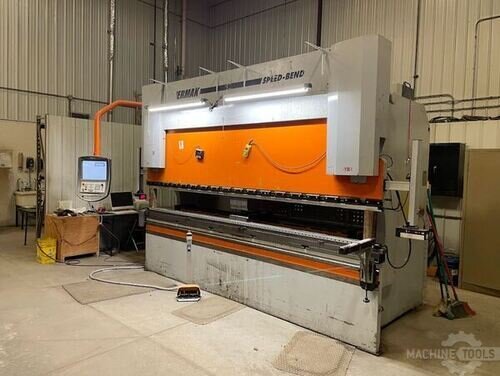
ERMAKSAN SPEED BEND PRO
OEM light curtain and pedal switch replacement on Ermaksan brakes for dependable safety and control
Light curtains fail due to internal channel drift, LED emitter degradation, cracked lenses, or controller faults. Pedals cause nuisance trips or no-start conditions when contacts pit, springs weaken, or ingress compromises the seal.
When I replace these components, I select the exact OEM set so channel resolution, height, and controller compatibility match Ermaksan parameters. That means correct pinouts, proper EDM or reset logic, and pedal redundancy aligned with the safety category in the machine.
Light curtain replacement steps I coordinate:
- Lockout-tagout and baseline function check with error code capture.
- Confirm curtain height, resolution, protected field, controller type, and bracket geometry.
- Install transmitter and receiver with vibration isolation; route cables with strain relief.
- Align using OEM tools and confirm correct blanking or muting configuration if present.
- Validate with stop-time measurement, zone test, and safety distance confirmation per ISO 13855.
Foot pedal replacement steps I coordinate:
- Inspect mounting channel, pedal guard, and conduit path for contamination or damage.
- Replace OEM pedal assembly and verify dual-channel 24 VDC signals at the safety controller.
- Check mechanical return force and ensure no binding; install new seal and boot if applicable.
- Perform redundancy and timing tests so the control sees symmetrical channels with no lag.
Why OEM accuracy matters:
- Verified channel resolution prevents unintended blanking and ensures finger or hand protection as designed.
- Correct controller integration maintains Category 4, PL e performance without bypasses.
- Matching pedal contact geometry and spring rate preserves consistent stroke and repeatable response.
I apply the same discipline across HSG lasers, Hydmech saw interlocks, Akyapak roll lines, Prodevco beam systems, and Wilson Tool integrated setups, so mixed-brand shops get consistent safety outcomes and documentation.
Warning signs of worn light curtains and foot pedals that can stop production
Intermittent Not Ready states usually point to marginal alignment, cable breaks, or LED emitter decay. Pedal wear shows up as delayed stroke acknowledgment, inconsistent starts, or E-Stop channels that will not reset.
Symptoms to watch:
- Light curtain: dim or flickering status LEDs, frequent beam interruptions with no obstruction, channel error codes, cracked or hazed lenses, warm or noisy controller.
- Pedal: spongy feel, delayed actuation, double-command rejection by the safety relay, visible boot cracks, moisture or oil inside the housing.
- Control: nuisance safety trips during vibration-intensive bends, random resets after die changes, repeated EDM faults.
Quick diagnostics your team can perform:
- Verify clear line of sight and clean lenses; inspect for bracket shift or vibration.
- Check curtain alignment indicators and confirm no unexpected blanking zones.
- Flex-test cables at connectors while watching input status in diagnostics.
- Monitor dual-channel timing for the pedal in the control; channels should switch within the specified window.
- Run a documented stop-time test after any safety component work or major maintenance.
When to replace immediately:
- Any cracked lens, exposed cable conductor, or controller overheat.
- Pedal contacts that fail a dual-channel redundancy test or show intermittent continuity.
- Repeated safety relay trips tied specifically to the same device or channel.
Fast OEM parts sourcing and service coordination with Nicole Salato at Mac-Tech (nicole@mac-tech.com)
Time lost to repeat trips and misidentified parts is avoidable. I confirm the exact curtain and pedal configuration against the Ermaksan build, so installation is straightforward and validation passes the first time.
What I verify before dispatch:
- Machine model, serial, and control version
- Light curtain height, resolution, controller family, connector type, and bracket style
- Required functions such as EDM, external reset, muting, or blanking
- Foot pedal electrical rating, dual-channel design, IP seal class, and guard style
- Safety relay or safety PLC input compatibility and available channels
How I coordinate your service window:
- Align the tech visit with planned downtime and ensure needed hardware and documentation are ready.
- Provide pre-checklists for operators to capture current faults, photos, and measurements.
- After installation, complete functional test sheets, stop-time records, and safety distance verification for your compliance file.
Post-service follow-through:
- Update the machine’s service log with part numbers, test results, and next PM date.
- Schedule the next semiannual PM to revalidate curtain alignment, pedal condition, hydraulic health, and backgauge accuracy.
- Offer brief operator coaching on daily checks that prevent nuisance trips.
FAQ
How often should press brakes be serviced?
Press brakes should receive a hydraulic inspection and oil change every six months or 1,000 operating hours.
How can I tell if my laser needs optics replacement?
Watch for inconsistent cutting speed, wider kerf, or visible lens haze.
Does Mac-Tech provide parts for older machines?
Yes. Nicole verifies compatibility and supports service for both current and legacy models.
When should a light curtain be replaced instead of realigned?
Replace if lenses are cracked, emitters are dim, or controller faults persist after alignment and cable checks.
How long do foot pedals typically last in production environments?
In high-use shops, expect 12 to 24 months before contact or spring wear warrants replacement, depending on environment and duty cycle.
Can safety validation be documented for audits?
Yes. I provide stop-time records, functional test results, and safety distance verification for your files.
What information speeds up my parts confirmation?
Send the machine serial, control type, light curtain label photos, pedal label photos, and any current fault codes.
I am ready to help you plan maintenance, coordinate service, and get the right OEM safety parts on your Ermaksan brake. Email me at nicole@mac-tech.com to keep your team bending safely and consistently.
Get Weekly Mac-Tech News & Updates