
I grew up in the Midwest, where a handshake means something and production numbers do too. I have spent years inside real shops solving real bottlenecks with practical automation that pays back. As a Sales Executive at Mac-Tech, I bring hands-on time studies, process mapping, and a straight-talking approach to help structural steel fabricators move faster with less rework and less waste. When I recommend an HSG tube laser over a traditional saw, drill, or coper combo, it is because I have seen the cycle times, fit-up gains, and scrap reductions on the floor. If you want proof, I will run it with your parts and your operators.
Replace saws, drills, and copers in one setup with HSG tube lasers that add bevels, copes, slots, and part IDs
Traditional flow for HSS and open profiles usually means saw, mark-out, mag drill, coper, and sometimes a secondary bevel station. That is multiple setups, multiple clamps, and a lot of handling. An HSG tube laser collapses those steps into a single clamping with automated measurement. You feed the stick, the machine auto measures, rotates to the correct orientation, cuts the length, pierces holes and slots, machines copes, applies bevels, and etches part IDs and orientation marks. Your part comes off ready for fit-up.
Sales-based insight and solutions:
- One setup per part lowers touches and scrap risk while freeing skilled people from layout and drilling. Standardize typical connection details as macros so the operator loads a cut job and runs.
- Build a part library for recurring jobs. IDs etched on the material tie directly to your traveler and drawing, which cuts sort time and prevents mix-ups at the weld cell.
Machine recommendations:
- HSG TS series for 2D cutting of square, rectangle, round tube with auto-loading options.
- HSG TH or TX series with 3D bevel head for bevels, copes, and complex end preps in one pass. Select models support open profiles with dedicated supports and software.
Technical and logistical knowledge:
- Floor space planning for a loader and 6 to 12 meter bed length, with straight, unobstructed infeed for bundles.
- 480 V 3-phase power, oxygen and nitrogen supply sized to your thickness mix, dust and fume extraction, and safe forklift or crane lanes for sticks and finished kits.
- Progressive assembly: parts come off labeled and oriented, sorted into kits staged by weld bay, which cuts travel and rehandling.
Deliver straighter cuts and faster fit-up on HSS, channel, angle, and I-beam using auto-centering chucks and real-time profile compensation
Sawed ends and drilled holes are often a little out because of blade deflection, clamp slip, or tube bow. Tube lasers use auto-centering chucks that grip without distortion and support the stick through the cut. Real-time profile compensation uses encoders and sensors to keep the cut path true even when the tube has seam height or slight bend.
Sales-based insight and solutions:
- Straighter ends and accurately placed holes reduce grinding and shim work at the weld table. That improves first-pass yield and stabilizes your takt time.
- Add tab-and-slot features so parts self-locate in fixtures and reduce tack time.
Machine recommendations:
- HSG auto-centering pneumatic chucks with servo follow support on TS and TH series for consistent clamping and reduced runout.
- Optional open-profile attachments for channel, angle, and I-beam on selected models to support structural profiles.
Technical and logistical knowledge:
- Expect tighter and more repeatable cuts than a band saw, which improves fit-up time. Many shops see weld cell time drop because gaps and end squareness are consistent.
- For open profiles, incorporate additional support rollers and confirm section dimensions in the CAM to maintain cut accuracy.
- Progressive assembly: use etched centerlines, datum marks, and hole IDs to speed fixture loading and QC.
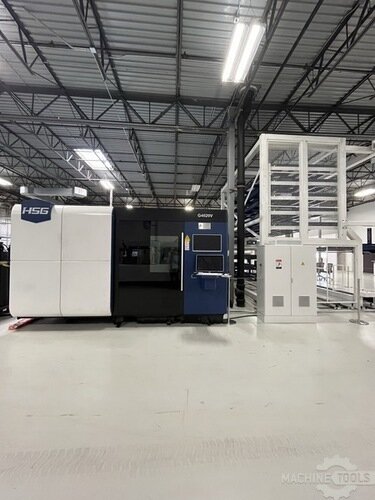
HSG G4020V 6G 30KW + STORE 4020 6
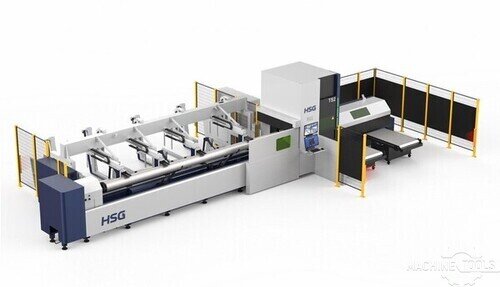
HSG TS2 HIGH SPEED TUBE FIBER LASER CUTTING MACHINE
Slash setup and cycle time with bundle loading, auto seam detection, smart nesting, and offline programming I commission with your lead operator
Bundle loaders reduce your material changeovers and let one operator manage a long run. Auto seam detection rotates the seam to your preferred clocking so slotting and copes avoid the seam. Smart nesting squeezes maximum parts per stick and groups jobs by material and length to minimize swaps. Offline programming lets you prep jobs during the day and run lights out where appropriate.
Sales-based insight and solutions:
- We build job templates around your most common families so your team loads a program, confirms stick type, and presses cycle start.
- I will commission offline programming with your lead operator, set up cut libraries by thickness and grade, and create proven macros for common connections like end miters, saddle copes, and bolt-hole patterns.
Machine recommendations:
- HSG bundle loader with auto-separation and single-bar feed for round and rectangular tube.
- Auto seam detection and rotation package to protect cut quality and avoid seam piercing.
- HSG CAM or equivalent offline programming seats networked to your server for revision control.
Technical and logistical knowledge:
- Stage bundles by job and thickness to reduce changeovers. Use barcode job packets or digital travelers to load correct programs quickly.
- Typical cycle-time savings compared to saw plus drill plus coping are substantial. Cutting, hole-making, and coping in-line often reduces total part time by 30 to 70 percent depending on geometry.
- Progressive assembly: nest parts by kit sequence so downstream sees the order they will weld, which cuts walking and sorting.
Waste less material and cash through tight kerf, remnant recovery, and ERP-linked scrap tracking I configure to match your stock strategy
Saws have a wider kerf and leave longer end trims. A fiber laser has a narrow kerf, short lead-ins, and can run closer to the chuck, which means more parts per stick. Remnant recovery routines capture the tail, mark the usable length, and return it to inventory. Linking program nests to your ERP lets you track scrap per job and refine buy lengths.
Sales-based insight and solutions:
- Set up kerf tables, micro-joints, and part spacing by material so you save material without risking part movement.
- Tie remnant labels to ERP item codes so your team pulls the right drop next time instead of cutting into a full stick.
Machine recommendations:
- HSG remnant management with automatic measurement and etching of tail length.
- Integrated part ID or label printer to track drops by job and heat number.
- CAM-to-ERP link via CSV or API to push planned usage and pull stock availability.
Technical and logistical knowledge:
- Expect a laser kerf roughly around 1 millimeter depending on nozzle and gas, which is tighter than most saws. That difference adds up across large runs.
- Maintain consistent nozzle height and gas selection for clean edges that do not need secondary cleanup.
- Progressive assembly: kits travel with heat and drop IDs, which supports traceability and reduces scrap in rework.
Scale skilled output with 3D bevel cutting, repeatable tolerances, and operator-friendly controls your crew adopts on day one
Bevels that used to require a coper or grinding can be cut on the laser with consistent angles and land. That means root openings are predictable and the welder moves faster with fewer adjustments. HSG controls are designed for quick adoption so new operators can handle loading and cycle management while experienced fabricators focus on higher value tasks.
Sales-based insight and solutions:
- Use 3D bevel cutting for K, V, and compound bevels up to common angles, and build standard bevel macros for your connection library.
- Start with two operators cross-trained for loading and programming. Add lights-out runs for repeat families after we validate part stability.
Machine recommendations:
- HSG TH or TX series with 3D bevel head for structural bevels and complex copes.
- Operator-friendly control with touchscreen, built-in diagnostics, and remote support.
Technical and logistical knowledge:
- Plan for 2 to 3 days of on-site training that covers safety, setup, calibration, and preventive maintenance. Include QC checkpoints for first-off verification.
- Keep spare consumables on hand, such as nozzles, lenses, and filters. Schedule weekly nozzle alignment and support bed checks.
- Progressive assembly: repeatable tolerances support standard fixtures, which accelerates weld time and reduces clamp adjustments.
Prove ROI on your parts: on-site time studies, payback models, and service plans I build with your team for confident growth
I will run side-by-side time studies with your saw and drill flow against an HSG tube laser program. We document cut time, hole time, changeovers, handling, scrap, and rework. Then we build a payback model that includes labor, consumables, gas, utilities, training, and service. The goal is to show clear, conservative payback with upside on repeat work.
Sales-based insight and solutions:
- We size machine power, bed length, and loader configuration to your exact part mix. No overbuying, no wishful thinking.
- Service plans include preventive maintenance, remote diagnostics, and on-site response times that match your production risk.
Machine recommendations:
- Power options sized to your thickness range so you do not overspend on wattage you will not use day to day.
- Loader and support packages tailored for HSS and any open-profile work you plan to run.
Technical and logistical knowledge:
- Include floor flow, crane paths, gas storage, and fume extraction in the ROI model. Small layout decisions add real throughput.
- Progressive assembly: model the impact of kitting and labeled parts on downstream labor so the ROI captures full system savings, not just cutting time.
FAQ
How fast is a tube laser compared to a saw and drill on typical HSS parts?
- On mixed parts with holes and copes, many shops see total part time drop by 30 to 70 percent because cutting, hole-making, and beveling run in one continuous cycle.
What profiles can we run beyond square and rectangular tube?
- Round tube is standard, and selected HSG setups handle channel, angle, and I-beam with dedicated supports and software. We verify your exact sections during a run-off.
Do we need a high-power laser to cut structural wall thicknesses?
- Not always. We size power to your most common thickness. The goal is consistent edge quality with the lowest operating cost.
How hard is it for operators to learn?
- Most crews run basic jobs on day one. We train on loading, program selection, and QC, then ramp into advanced features like bevels and nesting.
Can we track drops and scrap automatically?
- Yes. Remnant recovery routines mark tail length and ID, and we can link nests to your ERP so scrap and usage are visible by job.
What about maintenance and uptime?
- We set a preventive maintenance schedule, stock critical consumables, and provide remote support. Consistent PM keeps uptime high and cut quality stable.
If you want to see how this will perform on your parts and with your crew, I am happy to visit, measure the current process, and build a no-nonsense plan. Reach me anytime at kyle@mac-tech.com or 414-704-8413.
Get Weekly Mac-Tech News & Updates
