
Why Automation Is No Longer Optional in Midwest Fabrication
Across Indiana and the broader Midwest, fabrication leaders are facing the same pressures: skilled labor shortages, compressed lead times, and rising expectations for quality and traceability. Trade publications such as The Fabricator and IndustryWeek have consistently highlighted automation as a primary lever for maintaining throughput without scaling headcount at the same rate.
For operations running high-mix, medium- to high-volume work, unattended or lightly attended processing is becoming a competitive requirement. That’s where RYTECH automation solutions—available through Mac-Tech—enter the conversation.
What RYTECH Brings to the Fabrication Floor
RYTECH systems are designed to integrate with laser cutting platforms and related fabrication equipment to automate material handling, loading, unloading, and part flow. Rather than focusing solely on machine speed, RYTECH solutions address the full production cell—where real throughput gains are realized.
Key performance impacts for fabrication leaders include:
- Higher effective machine utilization: Automation reduces idle time between sheets or jobs, increasing the percentage of time the laser is actively cutting.
- Improved labor allocation: Operators can oversee multiple processes or move to higher-value tasks such as programming, quality checks, or downstream forming.
- Consistent material handling: Automated loading and unloading reduces variability and the risk of damage or misalignment.
- Safer workflows: Minimizing manual sheet handling supports safer operations in line with general OSHA guidance on material handling risk reduction.
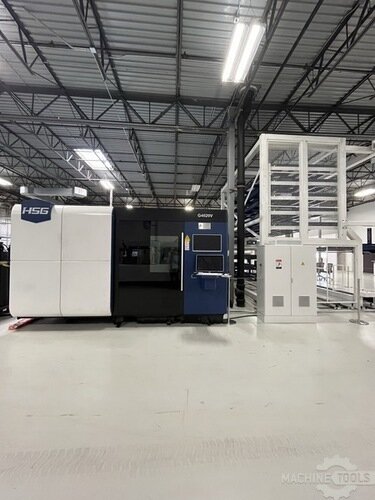
HSG G4020V 6G 30KW + STORE 4020 6
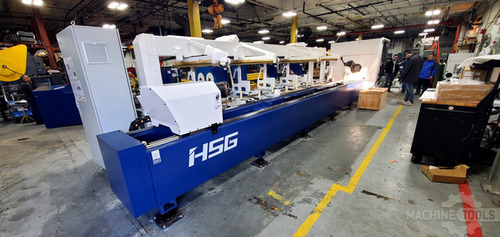
HSG R2
Throughput: The Metric That Matters
Laser manufacturers such as Bystronic and TRUMPF emphasize that total productivity is driven not just by beam power, but by material flow and process integration. Even the fastest laser cannot deliver ROI if it waits on an operator or forklift.
RYTECH automation supports a shift from “machine-centric” thinking to “cell-centric” performance. When material is staged, loaded, cut, and sorted with minimal interruption, the entire value stream tightens. For Indiana fabricators serving automotive, agriculture, construction, and structural markets, that improvement directly affects on-time delivery and customer retention.
Uptime and Predictability in a Tight Labor Market
Midwest manufacturers continue to report challenges recruiting and retaining skilled operators. Automation mitigates this risk by stabilizing output regardless of shift variability.
When a RYTECH system is integrated correctly:
- Changeovers become more repeatable.
- Night or lights-out production becomes feasible for appropriate job mixes.
- Production planning gains predictability, supporting more accurate quoting and scheduling.
For leaders focused on EBITDA and long-term valuation, predictable output is often more valuable than incremental speed increases.
Integration Is Where ROI Is Won or Lost
Automation does not operate in isolation. Successful deployment requires alignment between:
- Laser cutting platforms
- Nesting and production software
- Press brake and downstream forming capacity
- Material staging and warehouse layout
Trade coverage in Automation World and Manufacturing.net continues to stress that automation projects succeed when they are treated as system-level upgrades rather than bolt-on accessories.
That is particularly important in established Midwest shops where floor space, legacy equipment, and building constraints shape every investment decision. A well-planned RYTECH installation should enhance flow—not create new bottlenecks at deburring, bending, or welding.
Strategic Considerations for Indiana Fabricators
Before investing in automation, fabrication leaders should evaluate:
- Current machine utilization: Are lasers waiting on material?
- Shift structure: Is a second or third shift limited by labor availability?
- Job mix stability: Are there repeat families suitable for automated runs?
- Downstream capacity: Can forming and assembly keep pace with higher cutting output?
When these factors align, RYTECH automation can help convert theoretical machine capacity into realized throughput—often the difference between flat growth and scalable expansion.
Quality and Reputation in Competitive Markets
Consistency in loading, alignment, and part handling reduces rework and protects finished surfaces. For fabricators supplying OEMs or structural applications, maintaining dimensional accuracy and minimizing cosmetic defects supports long-term customer relationships.
Organizations such as SME and PMA frequently note that digital integration and automation are core components of modern manufacturing competitiveness. RYTECH systems fit squarely within that evolution—helping Midwest fabricators maintain quality standards while increasing output.
Building a Resilient Fabrication Operation
Automation is not about replacing people; it is about protecting throughput, stabilizing margins, and enabling growth. For Indiana and Midwest fabricators navigating labor constraints and rising expectations, RYTECH automation offers a structured path toward higher utilization and improved ROI.
If you are evaluating how automation fits into your current laser cutting environment, this is the time to step back and assess the full production cell—not just the machine on the floor. Consider your throughput goals, labor strategy, and long-term growth plans.
If you’d like to explore how RYTECH automation could support your specific operation, use the contact form below to ask questions, share your current challenges, or request guidance. Fabrication performance is rarely about one component—it’s about smart integration. Let’s discuss how to align your automation strategy with your business objectives.
Related Video
Precision. Power. Performance — Meet the Rytech CORE+ | Mac-Tech
Sources
- Mac-Tech – RYTECH Brand Overview
- The Fabricator – Automation and Laser Productivity Coverage
- Bystronic USA – Laser System Integration and Automation Concepts
- Automation World – Manufacturing Automation Trends
Get Weekly Mac-Tech News & Updates
