
The Press Brake Is No Longer a Standalone Machine
For fabricators across Indiana, Illinois, Michigan, and Wisconsin, the press brake has evolved from a simple bending tool into a central node in a connected production environment. Whether you’re supporting automotive supply chains in Fort Wayne, structural steel projects in Gary, or heavy equipment fabrication in South Bend, your press brake now plays a direct role in throughput, labor efficiency, and quality control.
Recent OEM guidance and industry reporting emphasize that modern press brakes are increasingly integrated with automation, offline programming, and data-driven controls. Manufacturers such as Bystronic and TRUMPF highlight the growing importance of networked controls and programmable backgauge systems to improve repeatability and reduce setup time. For contract metalwork shops operating on tight margins, that integration is no longer optional—it’s strategic.
Automation and CNC Controls: What’s Driving Investment
Press brake OEMs including Bystronic and LVD continue to advance CNC capabilities, adaptive bending, and automated tool change systems to reduce operator intervention. Delem, a leading press brake control manufacturer, documents how advanced CNC platforms enable 2D/3D programming, real-time angle correction, and material compensation—features that directly impact first-pass yield and scrap reduction.
Trade coverage in publications such as The Fabricator and MetalForming Magazine over the past year has reinforced a consistent theme: shops investing in automation report measurable gains in consistency and reduced reliance on highly specialized manual operators. In the Midwest, where skilled labor shortages remain a persistent issue, this matters.
Practical takeaway:
- Evaluate whether your current press brake supports offline programming.
- Assess repeat jobs where automated angle measurement could reduce rework.
- Consider whether robotic tending makes sense for high-volume parts.

EVO III – INDUSTRIAL CNC PRESS BRAKE EVO III
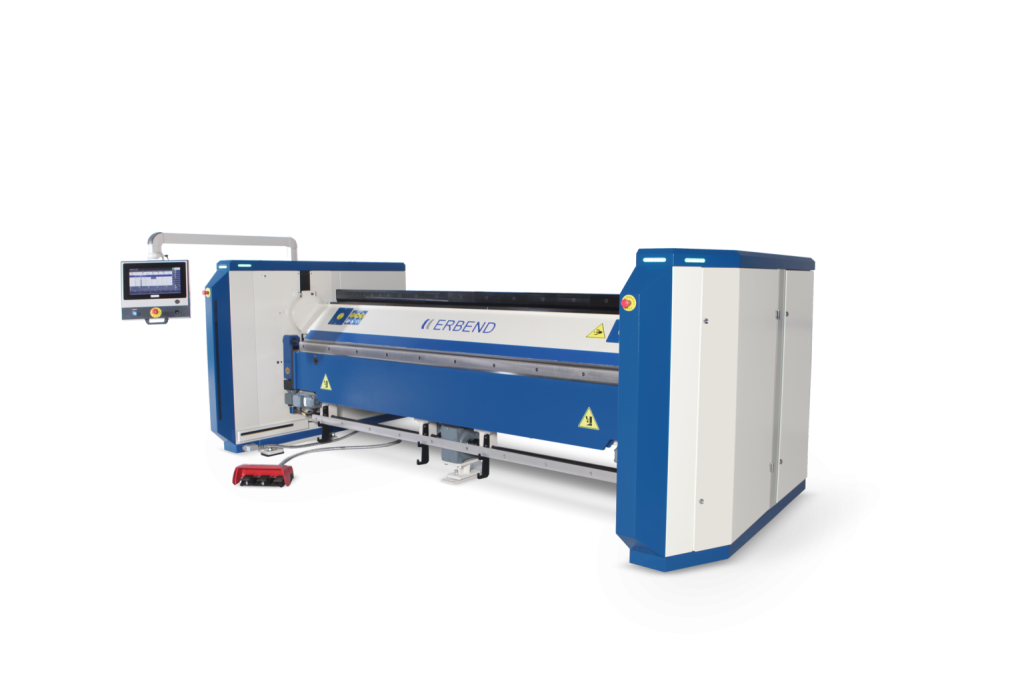
ERBEND MFD STEEL SHEET FOLDING MACHINE
Matching Tonnage and Bed Length to Regional Demand
Structural steel and heavy equipment fabrication remain strong across the Great Lakes region. According to the American Institute of Steel Construction (AISC), ongoing infrastructure and industrial projects continue to support demand for fabricated steel components. That translates directly into requirements for higher tonnage capacity and longer bending lengths in many shops.
However, oversizing equipment can negatively affect ROI. Press brake manufacturers including Accurpress and Ermaksan stress proper tonnage calculation based on material type, thickness, and bend length. Overbuying capacity ties up capital; underbuying limits contract eligibility.
Practical takeaway:
- Map your top 20% revenue-generating parts.
- Verify required tonnage using OEM tonnage charts.
- Align machine capacity with projected 3–5 year market demand.
Energy Efficiency and Operating Costs
Energy pricing volatility across the Midwest has pushed many fabricators to compare hydraulic, hybrid, and electric press brake platforms. Electric systems eliminate hydraulic oil and reduce idle energy consumption, while hybrid systems aim to balance power and efficiency.
OEM technical documentation from multiple press brake manufacturers shows measurable reductions in energy use for servo-electric systems, particularly in high-cycle, lighter-gauge applications. For shops running multiple shifts in Indianapolis or Elkhart, that operational savings compounds over time.
Practical takeaway:
- Calculate total cost of ownership, not just purchase price.
- Include energy use, maintenance intervals, and tooling compatibility.
- Compare hydraulic vs. hybrid vs. electric for your part mix.
Safety, Compliance, and Risk Reduction
OSHA guidance continues to emphasize safeguarding and operator protection in metal fabrication environments. Modern press brakes incorporate light curtains, laser-based guarding, and programmable safety zones that help reduce injury risk while maintaining productivity.
For business owners, safety upgrades are not only about compliance—they protect workforce stability and reduce costly downtime from incidents.
Integration with Lasers and Downstream Processes
Midwest fabricators increasingly operate fiber lasers alongside CNC press brakes. When these systems share compatible software platforms, programming errors decline and changeovers accelerate. Industry reporting in Manufacturing.net and Automation World has highlighted how digital integration improves workflow transparency and scheduling accuracy.
For contract shops in Evansville or Columbus serving OEM supply chains, this integration can shorten lead times and improve on-time delivery metrics—critical factors in winning repeat business.
Questions Every Midwest Fabricator Should Ask Before Upgrading
- Is our current press brake limiting the type of contracts we can bid?
- Are we compensating for machine limitations with excess labor?
- Do we have data to justify automation or robotic bending?
- Is our equipment aligned with the industries we plan to serve in the next five years?
The Strategic View: Press Brakes as Growth Tools
In 2026, a press brake purchase is not just a machinery decision—it’s a growth strategy. For industrial fabrication, automotive supply, heavy equipment manufacturing, and structural steel producers across Indiana and the broader Midwest, bending capacity directly affects competitiveness.
The most successful shops treat press brakes as part of an integrated production ecosystem—linked to lasers, tooling strategy, workforce planning, and long-term capital expenditure goals.
If you’re evaluating a new press brake, considering automation, or simply questioning whether your current equipment is holding you back, this is the right time to step back and assess strategically. Use the contact form below to ask your questions, share your production challenges, or explore upgrade options. A thoughtful conversation today can prevent costly missteps tomorrow—and position your operation for stronger, more predictable growth.
Related Video
Delem 58T CNC Press Brake Controller Walk Through
Sources
- Bystronic USA – Press Brake Technology Overview (bystronic.com)
- Delem – CNC Control Systems for Press Brakes (delem.com)
- American Institute of Steel Construction (aisc.org)
- The Fabricator – Press Brake Automation and Productivity Coverage (thefabricator.com)
Get Weekly Mac-Tech News & Updates
