
In the field, I keep seeing the same story: the forming machine is fast enough, but the line never runs at its rated speed because coil staging, inconsistent leveling, and downstream handling force stops that nobody planned for. The bottlenecks show up as mystery downtime, late orders, and operators making judgment calls to keep parts moving, which is where scrap, rework, and unsafe coil handling creep in. When coil-to-part planning is done right, throughput becomes predictable because every module is scoped around a stable material flow, not just a peak cycles-per-minute number. My job is to help shops build that stability so ROI comes from repeatable output, not optimistic assumptions.
Mapping Coil to Finished Part Material Flow to Eliminate Bottlenecks
Most throughput problems start with an incomplete map of how material actually moves from coil storage to finished-part staging. If the coil car, uncoiler, leveler, feed, forming, and cut-to-length are not paced to the same reality, you get starving, blocking, and unplanned accumulation that forces manual intervention.
Material flow map that prevents bottlenecks:
- Coil receipt and staging rules by width, gauge, and alloy
- Coil loading method and changeover sequence with lift constraints
- Leveling and feed capacity matched to the slowest downstream module
- Post-form handling path to pallets, skids, or racks with no backtracking
- Quality gates placed where they stop bad parts early, not at the end
In practice, I plan the line around the true constraint, which is usually coil prep stability or downstream part evacuation. A staged approach can work if the shop needs to keep producing, but the material flow map has to reflect the final target state so every intermediate upgrade is still moving toward predictable scheduling and labor reallocation.

MRGM-H 2060
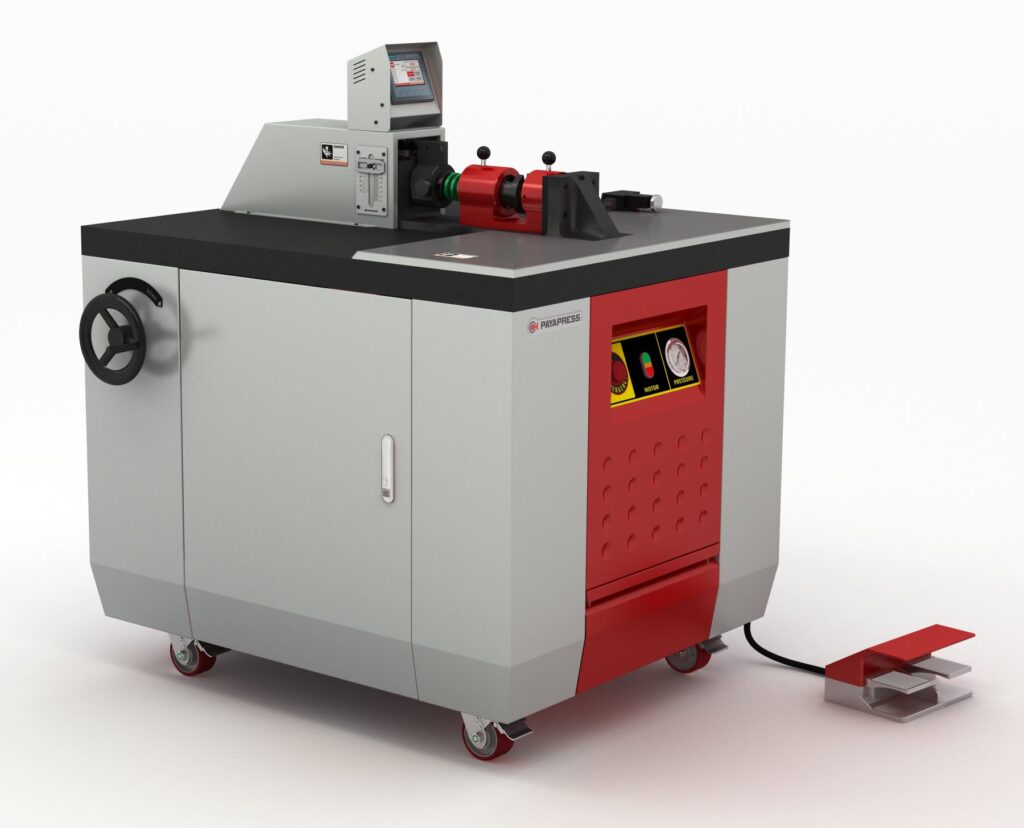
PAYAPRESS WORKSHOP BUSBAR PROCESSING MACHINE
The Payapress HBC-PC120EH Workshop Busbar Processing Machine is an economical 3-in-1 solution designed to punch, cut, and bend copper and aluminum busbar. Its compact footprint makes it ideal…
Sizing Uncoiling, Leveling, and Servo Feed for Predictable Line Speed
Shops often overspend on forming capability while under-scoping the uncoiler, straightener, or servo feed, which is the real governor on line speed and repeatability. When leveling is marginal, you see oil-canning, twist, and inconsistent bend lines that create rework and downstream adjustment.
Sizing criteria that stabilize line speed:
- Coil weight, OD/ID, and changeover frequency driving uncoiler choice
- Material yield strength and gauge range dictating leveler roll count and diameter
- Required feed accuracy and acceleration driving servo feed selection
- Loop control or accumulator needs to buffer intermittent downstream processes
A servo feed paired with properly sized leveling gives you repeatable progression and reduces part-to-part variation, especially on high-strength steels or long panels. Hydraulic systems can be fine for simpler applications, but servo control typically wins when you need tight length tolerances, faster recovery after stops, and less operator tuning to hold schedule.
Selecting Slitting, Shearing, Folding, and Rolling Modules to Meet Part Tolerances
If tolerances are drifting, the root cause is usually mismatch between process capability and the part family, not operator skill. Slitting quality, shear squareness, and forming method selection determine whether you are chasing dimensions all shift or building repeatable parts that pass the first time.
Module selection tied to tolerance outcomes:
- Slitting head and tooling quality for burr control and edge condition
- Servo-driven or precision shearing for consistent length and squareness
- Folding vs roll forming decision based on profile complexity and batch size
- Inline vs offline secondary operations to reduce handling touches
For high-mix panel work, a panel bender can outperform traditional folding on repeatability and changeover, especially when part families share material and thickness. For long runs with consistent profiles, roll forming with the right tooling strategy delivers the lowest cost per part, and pairing it with Mac Shear cut-to-length or an integrated shear module can lock in length control and reduce downstream sorting.
Automation, Changeover Strategy, and Controls Integration for OEE and Labor Reduction
The hidden tax in coil-to-part is setup time, not cycle time. If the line needs three people to keep it running, or if changeovers require tribal knowledge, you end up with unstable OEE and production planning that always includes padding.
ROI drivers in automation and controls:
- Quick-change tooling and preset recipes for thickness and width families
- Automatic coil loading aids like coil cars and threading tables
- Integrated controls and fault diagnostics to shorten recovery time
- Part handling automation to eliminate stop-start accumulation
I like to integrate controls so the uncoiler, leveler, servo feed, and downstream modules react together, not as islands that fight each other. You can do this as a full line integration or staged upgrades, but the payoff is the same: fewer hands on the line, faster setups, consistent part quality, and scheduling that stops being a guessing game. For scoping and configuration options, I often point teams to current coil systems and line components at https://shop.mac-tech.com/ so we can align features with real production needs.
Safety, Scrap Reduction, and Maintenance Planning That Protects Uptime and ROI
Unsafe coil handling and reactive maintenance are two of the fastest ways to destroy ROI. When operators are guiding strip by hand, reaching into pinch points, or fighting recoil and edge curl, you see more injuries, more damaged tooling, and more unplanned downtime.
Uptime protection plan built into the line:
- Coil loading and threading steps designed to keep hands out of the line
- Edge and scrap management to prevent jams and floor hazards
- Scheduled wear inspection points for leveler rolls, feed rolls, and shear blades
- Early quality checks to stop scrap before it becomes a full-coil event
Scrap reduction is also a quality gate problem, not just a forming problem. Placing measurement checks right after leveling and first-article validation after a changeover catches drift before you run a pallet of bad parts, and it makes maintenance proactive instead of a crisis when tolerance suddenly collapses.
Next Steps for a Data-Driven Coil-to-Part Line Upgrade Plan as H2 headings (##). Write 2–4 short paragraphs per section (2–4 sentences each).
The fastest way to get predictable throughput is to start with real production data, not hoped-for rates. I ask for part families, gauges, material types, coil widths, order mix, and the throughput target in parts per hour with an honest view of changeover frequency and staffing.
Inputs I use to scope the right line:
- Part drawings or profiles and tolerance requirements
- Gauge range, yield strength, and surface sensitivity
- Coil specs and how coils are received, stored, and staged
- Target OEE, shift pattern, and labor constraints
From there, we build a phased plan that shows what you gain at each step, whether that is upgraded coil prep first, a new forming module, or full controls integration. If you want a clear starting point on equipment options and upgrade paths, review current coil-to-part components and modules at https://shop.mac-tech.com/ and we can align that to your floor space and ROI timeline.
FAQ
When should I upgrade the roll former, folder, shear, or coil line?
Upgrade when quality is stable only at slow speeds, changeovers are unpredictable, or coil handling and leveling cause chronic stops that cap throughput.
Servo vs hydraulic forming tradeoffs, what matters most?
Servo typically delivers better repeatability, acceleration, and recipe-based control, while hydraulic can be cost-effective for simpler profiles and lower changeover demands.
What is the best setup reduction and tooling change strategy?
Standardize around part families, use quick-change tooling where it pays back, and tie machine recipes to measured first-article checks to avoid trial-and-error setups.
What coil handling improvements reduce labor and improve safety fastest?
Coil cars, powered threading aids, and properly designed entry guides remove manual strip control and reduce pinch-point exposure while speeding coil changeovers.
When does a panel bender make sense for high-mix production?
When you run many short batches with frequent angle changes and need consistent bends with minimal operator dependence, a panel bender can stabilize both quality and throughput.
What maintenance planning prevents most coil-fed line downtime?
Plan inspections around leveler rolls, feed rolls, shear blades, and lubrication points, and track coil-related issues like camber and edge damage that accelerate wear.
What information do you need to size a coil-to-part system correctly?
I need profile drawings, gauge range, coil width and weight, material grade, tolerance targets, changeover frequency, and the throughput goal you want to hit consistently.
Reach out to me for a walkthrough, demo, or upgrade consultation at pat@mac-tech.com or 414-232-7929, and you can also explore options at https://shop.mac-tech.com/.
Get Weekly Mac-Tech News & Updates
