
I am Nicole Salato, Service and Parts Lead at Mac-Tech. Every day I help shops keep their Rytech press brakes producing with smart troubleshooting, dependable parts sourcing, and clear communication. When hydraulic issues pop up, I move quickly to resolve the root cause, protect your schedule, and avoid repeat failures.
Quick Diagnostics for Rytech Press Brake Hydraulics: Pressure, Fluid, Filters, Leaks, Valves
Start with safety. Lockout and tagout the machine, bleed residual pressure, and use proper gauges and PPE.
- System pressure
- Verify actual pressure at the manifold test port against the CNC command and Rytech spec. If pressure is low, confirm the relief valve setpoint, inspect the pump coupling for wear, and check for motor rotation errors after recent electrical work.
- If the machine has a pressure transducer, check scaling in the control and inspect the sensor for drift. A 0 V or pegged signal often points to a broken cable or failed transducer.
- Hydraulic fluid condition
- Look for darkened fluid, burnt odor, or milky appearance. Milky fluid indicates water contamination, which reduces tonnage and accelerates wear.
- Measure temperature during production. Excess heat will slow cycles and drop force. Verify cooler fan operation, heat exchanger cleanliness, and ambient airflow around the tank.
- Confirm viscosity grade is per Rytech recommendations for your climate. Too light raises leakage, too heavy starves the pump on cold starts.
- Filters and suction strainers
- Check the return filter clog indicator. If it pops frequently, you likely have contamination or varnish in the system.
- Inspect and clean the suction strainer. A restricted inlet causes cavitation noise and foamy oil.
- Replace filters with the correct micron rating and bypass setting to protect proportional valves and cylinders.
- Leaks and drift
- External leaks at fittings, hoses under the ram, and manifold O-rings are common and easy to spot.
- Cylinder drift with the machine stopped usually indicates internal bypass in a cylinder or valve. A blocked tank line can mimic drift by trapping pressure, so verify line integrity.
- Valves and control
- Listen and feel for solenoid actuation. Measure coil resistance and verify power from the I/O. A weak coil or damaged connector can cause intermittent faults.
- Proportional or servo valve spools can stick when oil is dirty or cold. If a tap frees motion, plan a fluid and filter change and schedule a valve service before it fails again.
- Review CNC alarms. Following errors on Y1 or Y2, inconsistent pressure build, or slow approach often trace to poor fluid condition or failing feedback devices.
- Pump and motor checks
- If pressure rises slowly and the pump is noisy, look for inlet restriction or aeration. Inspect flexible coupling and alignment. Measure case drain flow to estimate internal pump wear.
- Verify incoming power balance and motor amperage under load.
If you need a fast triage call, email nicole@mac-tech.com with the alarm text, pressure reading, oil temperature, a short video, and the machine serial number.
Preventative Maintenance That Extends Hydraulic Life and Reduces Downtime
- Daily
- Warm the machine before full tonnage work, especially in cold environments.
- Check for alarms, unusual noise, leaks, and oil level. Keep the light curtains and scales clean.
- Monthly
- Inspect return filter indicator and suction strainer. Wipe manifolds and hose connections to detect new seepage.
- Verify cooler fan and heat exchanger cleanliness. Confirm reservoir breather function.
- Quarterly
- Replace return filters per hours or differential pressure. Sample oil for viscosity, water, and particle count. Top off with the correct grade only.
- Check proportional valve cables and connectors. Inspect pump coupling and motor mounts.
- Back up CNC parameters and check battery status. Verify backgauge lubrication and travel accuracy.
- Annually
- Conduct a full hydraulic health check. Include tank cleaning if samples trend bad, cylinder rod inspection, and relief valve verification.
- Calibrate pressure transducer scaling and confirm tonnage against a certified load cell.
- Review spare parts on hand to cover filters, transducer, and a coil kit.
Consistent basics almost always cost less than a single emergency stop caused by contaminated oil or a starved pump.
High-Impact Replacement Parts and How Nicole Sources Them Fast
The parts that most quickly restore a Rytech press brake include:
- Return and pressure filters, suction strainer, and desiccant breather
- Pressure transducer and common I/O sensors for Y1 and Y2 axes
- Proportional or servo valve coil kits and seal kits
- Cylinder seal kits and common O-rings for manifold blocks
- Pump and coupling set, with keyway and hardware
- Cooler fan motor and thermostat
- Foot pedal switches and e-stop components
How I move fast:
- I start with your serial number, photos of the data plates, and symptom details. This confirms the exact BOM and avoids wrong-fit parts.
- I check multi-warehouse availability and qualified equivalents that meet Rytech specs when the OEM part is on backorder.
- I bundle a fix kit based on the failure mode, like filter plus fluid plus coil, so your first visit has the highest chance of a one-trip repair.
- I coordinate drop-ship direct to your dock, after-hours courier when needed, and customs-ready documentation for cross-border shipments.
Email nicole@mac-tech.com with serial, part need, and urgency. I will reply with price, lead time, and shipping options.
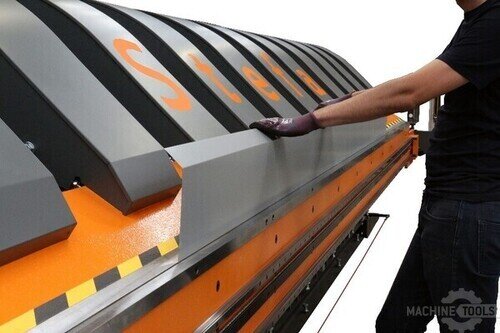
STEFA VH315

STEFA SLIT-BEND FOLDER WITH BUILT-IN SHEAR
When to Call Mac-Tech Service and How Nicole Coordinates Support (nicole@mac-tech.com)
Call us when you see:
- Persistent low pressure or tonnage shortfall after basic checks
- Cylinder drift greater than spec or ram will not hold position
- Aeration or foaming that returns after filter and fluid service
- Repeated filter clog alarms or rapid fluid darkening
- Unusual noise from pump or motor, tripping breakers, or hot oil
- CNC following errors on Y1 or Y2 that do not resolve with cleaning and recalibration
- A crash event, sudden leak, or a cooler failure
How I coordinate support:
1) Intake and triage
You send serial number, photos, videos, alarm text, and basic readings. I provide a structured checklist and initial steps to minimize downtime immediately.
2) Parts and prep
I pre-pick likely parts based on your symptoms and ship to meet the technician or your in-house team.
3) Scheduling
I align your production windows with the nearest qualified Mac-Tech technician. For critical stops I prioritize same or next business day when possible.
4) Onsite and follow-up
We document findings, complete the repair, verify tonnage and cycle performance, and schedule preventive actions. I follow with a parts usage summary and recommendations to prevent recurrence.
FAQ
Bold questions with italic answers.
How fast can you get common Rytech hydraulic parts?
- Most filters, transducers, coil kits, and breather elements ship same day from stock. Pumps, proportional valves, and cylinder kits often run 2 to 7 business days, with expedite options available.
What signs tell me the press brake needs service, not just maintenance?
- Repeat low-pressure alarms, drifting ram, overheating oil, new metallic noise, or a change in cycle timing point to component wear or failure that should be evaluated by a technician.
What preventative steps give the biggest payoff?
- Clean oil, correct viscosity, on-time filter changes, a healthy reservoir breather, and a verified relief setting. Add quarterly oil sampling and you will catch most issues before they stop production.
How does Mac-Tech handle urgent orders?
- I confirm the exact part from your serial number, check multiple inventories, quote lead time and freight options, and arrange drop-ship or hot-shot courier. You receive tracking and install guidance.
Can you help if my CNC shows pressure or Y-axis following errors?
- Yes. I will walk you through quick control checks, sensor validation, and pressure scaling. If needed, I dispatch a technician with the right parts and diagnostic tools.
- What information should I include in a service request?
- Serial number, model, hours, environment temperature, oil brand and grade, alarm text, current pressure and temperature, and a short video of the cycle or noise.
I am here to keep your Rytech running safely and profitably. Whether you need a quick parts quote, a diagnostic checklist, or a coordinated service visit, reach out and I will take it from there. Email nicole@mac-tech.com for fast support.
Get Weekly Mac-Tech News & Updates
