Upgrading from Legacy Workflows to HSG Fiber Laser Systems: A Practical Roadmap for Upper Midwest Fabricators
Why Many Upper Midwest Shops Are Re-Evaluating Older Cutting Workflows
Across Wisconsin, Minnesota, North Dakota, and South Dakota, fabrication production managers are under pressure to increase throughput without expanding headcount. Aging plasma tables, first-generation CO₂ lasers, and manual material handling systems often become bottlenecks—especially as customer demand shifts toward tighter tolerances and faster delivery cycles.
Fiber laser technology has matured rapidly over the past several years. According to HSG Laser’s product documentation, its fiber laser platforms are designed for high-speed sheet and tube processing with integrated automation options and intelligent control systems (hsglaser.com). At the same time, trade publications such as The Fabricator continue to highlight how fiber laser adoption is reshaping shop layouts and part flow by reducing secondary processing and manual intervention (thefabricator.com).
For operations leaders upgrading from legacy systems, the question is no longer whether fiber is viable—it’s how to implement it strategically.
From CO₂ and Plasma to Fiber: What Changes Operationally?
Moving to an HSG fiber laser system affects more than cutting speed. It changes how work flows through the shop.
Improved beam efficiency: Fiber systems use solid-state laser sources, which manufacturers such as IPG Photonics describe as highly efficient and compact compared to traditional gas lasers (ipgphotonics.com). This translates to lower electrical consumption per part in many applications.
Reduced maintenance complexity: Eliminating mirrors and gas resonators simplifies upkeep compared to older CO₂ architectures.
Cleaner edges on many materials: As reported in industry coverage by Laser Focus World, fiber lasers are widely adopted for their ability to process a range of metals with high precision and repeatability (laserfocusworld.com).
For Midwest fabricators handling agricultural equipment, structural components, trailers, enclosures, or metal building parts, these differences can directly influence labor allocation and scheduling reliability.
Sheet and Tube Integration: Rethinking the Production Cell
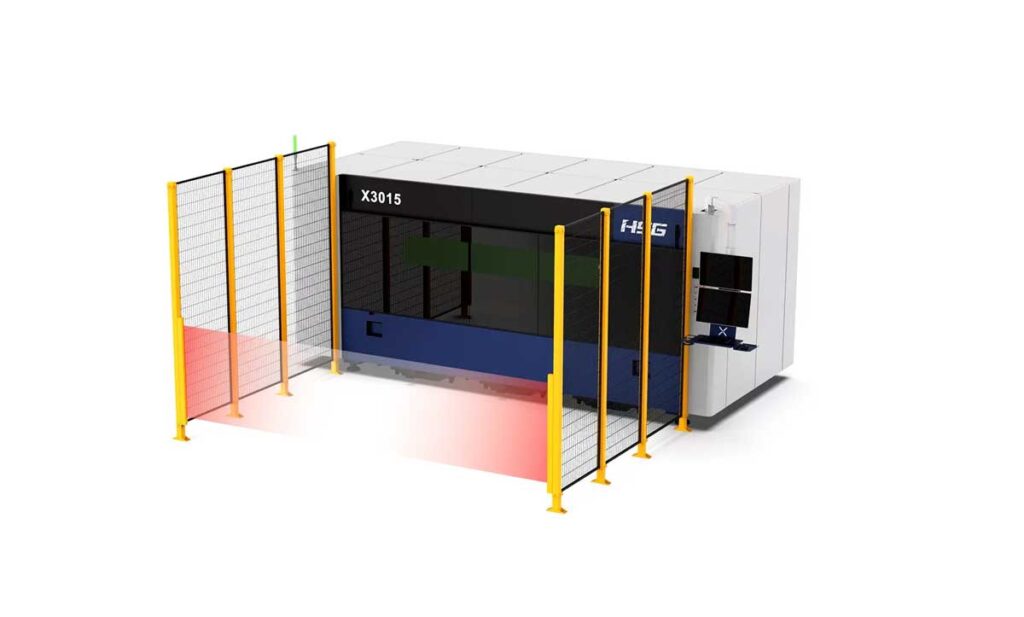
HSG’s portfolio includes both sheet and tube laser systems, as well as automation options for loading, unloading, and part sorting (hsglaser.com). For production managers upgrading from standalone cutting tables, this creates an opportunity to rethink layout and labor deployment.
Instead of treating cutting as a batch operation, many shops are shifting toward:
Automated sheet handling to reduce forklift traffic.
Integrated tube cutting that replaces multiple drilling, sawing, and coping steps.
Digital nesting and production scheduling tied to ERP systems.
Trade coverage in The Fabricator and Manufacturing.net consistently notes that automation paired with fiber cutting can help address skilled labor shortages by reducing manual repositioning and repetitive handling (thefabricator.com; manufacturing.net).
For shops in rural North and South Dakota where hiring is especially competitive, this integration can be as important as raw cutting speed.
Material Mix and Regional Considerations
Upper Midwest fabricators often process:
Carbon steel for structural and agricultural applications.
Stainless for food, dairy, and processing equipment.
Aluminum for transportation and light structural assemblies.
Fiber laser systems are widely recognized in technical literature for strong performance across these reflective and non-reflective metals (laserfocusworld.com). For operations teams, this flexibility reduces the need to route jobs to different machines based solely on material type.
In practical terms, that means fewer scheduling conflicts and more consistent lead times—two metrics that matter when serving OEM customers throughout the Midwest.
Evaluating ROI Beyond Cycle Time
When upgrading to an HSG fiber laser, production managers should evaluate ROI across multiple dimensions:
Throughput per shift rather than only inches per minute.
Secondary process reduction (deburring, grinding, rework).
Labor reallocation to higher-value forming or assembly work.
Floor space optimization when integrating automation towers or tube bundles.
Industry guidance from SME and related manufacturing publications emphasizes that capital equipment decisions are most effective when paired with process analysis and workflow redesign—not simply machine replacement (sme.org).
In other words, the greatest gains often come from pairing a fiber laser upgrade with a broader review of forming, welding, and material handling processes.
What Production Managers Should Ask Before Upgrading
Before committing to a new HSG system, consider these practical questions:
Is your current bottleneck truly cutting—or downstream forming and welding?
Can automation reduce forklift dependency and improve safety flow?
Do you have programming staff prepared for advanced nesting and control features?
Will tube processing eliminate multiple manual operations?
Answering these questions upfront helps ensure the upgrade supports long-term scalability rather than short-term capacity relief.
Planning for the Next Five Years
For fabrication leaders across Wisconsin and the surrounding states, fiber laser adoption is increasingly about stability and predictability. Customers expect shorter lead times. Skilled labor remains tight. Energy efficiency and machine uptime are under scrutiny.
HSG’s continued expansion of fiber laser and automation offerings reflects the broader shift within U.S. fabrication toward integrated, digitally managed production systems (hsglaser.com). Combined with insights from industry trade coverage, it’s clear that modern fiber platforms are no longer niche—they are becoming standard infrastructure for competitive shops.
If you’re evaluating whether now is the right time to transition from legacy workflows to an HSG fiber laser solution, it may be worth stepping back and reviewing your entire production flow—not just your cutting table. Consider how automation, sheet and tube integration, and smarter scheduling could reshape your shop over the next five years. If you have questions or want to explore how these systems fit your specific operation, use the contact form below to connect with the author and tap into practical, experience-based guidance.
Related Video
GX High Power Bus Sheet Fiber Laser Cutting Machine by Mac Tech
Sources
HSG Laser – Product and automation documentation: https://www.hsglaser.com/
The Fabricator – Fiber laser adoption and fabrication workflow coverage: https://www.thefabricator.com
Laser Focus World – Industrial fiber laser technology overview: https://www.laserfocusworld.com
SME – Manufacturing technology and process improvement resources: https://www.sme.org
With over 20 years in the fabrication industry, Kyle brings real-world experience to every customer conversation—from shop floors to boardrooms. He’s worked in job shops, ETO environments, and global OEMs, wearing nearly every hat: operator, trainer, scheduler, programmer, purchaser, and project manager. He’s also served on leadership boards, led ISO audits from both sides, and developed SOPs that actually work in practice—not just on paper.
Now a Sales Executive at Mac-Tech covering Wisconsin, Michigan, and Minnesota, Kyle helps fabricators make smarter equipment decisions that align with growth, efficiency, and long-term ROI. His approach is hands-on and collaborative—he listens, asks the right questions, and understands that every shop’s strength lies in its people as much as its machines.
A proud father of three and husband of 18 years, Kyle is a former youth sports coach who brings the same energy and team-first mentality to his professional life. When he’s not talking shop, you’ll find him outdoors, watching Wisconsin sports, playing fantasy football, or just soaking up time with his family.