
Why Metal Folding Matters More Than Ever
Across the United States—especially in industrial regions like Indiana—metal folding has become a critical performance driver for contract fabricators, automotive suppliers, heavy equipment manufacturers, and commercial metal producers. As material costs remain volatile and skilled labor remains tight, production leaders are reevaluating how folding operations affect throughput, quality, and operator safety.
For many shops in Indianapolis, Fort Wayne, Elkhart, Gary, Columbus, Evansville, and South Bend, folding is no longer just a secondary process behind cutting and punching. It is often the pace-setter for the entire line.
The Shift Toward CNC and Automated Folding
Modern CNC folders and panel benders are increasingly replacing manual brakes and older hydraulic folders. Manufacturers such as Salvagnini, RAS, CIDAN/Forstner, and others have emphasized automation, programmable controls, and integrated material handling to reduce setup time and manual repositioning.
According to OEM documentation from Salvagnini and RAS, automated panel bending systems are designed to:
- Minimize manual handling between positive and negative bends
- Store and recall part programs for repeat jobs
- Improve repeatability across high-mix, low-volume production
- Integrate upstream with laser cutting and downstream with stacking systems
For Indiana fabricators serving automotive and heavy equipment markets, this level of repeatability is essential for maintaining dimensional consistency across contract production runs.
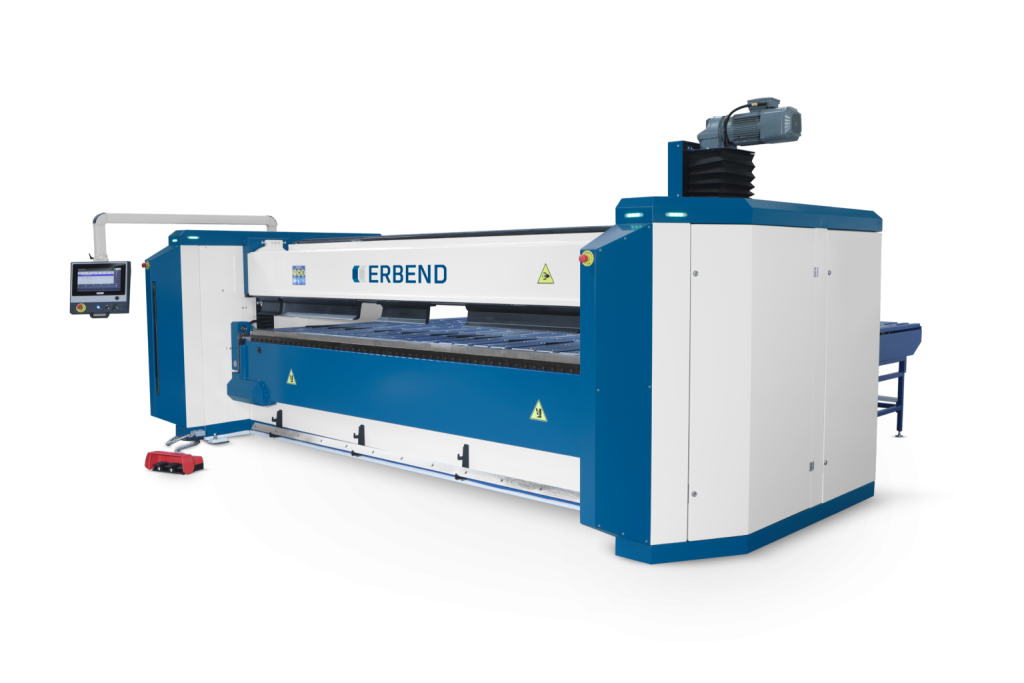
ERBEND MFA
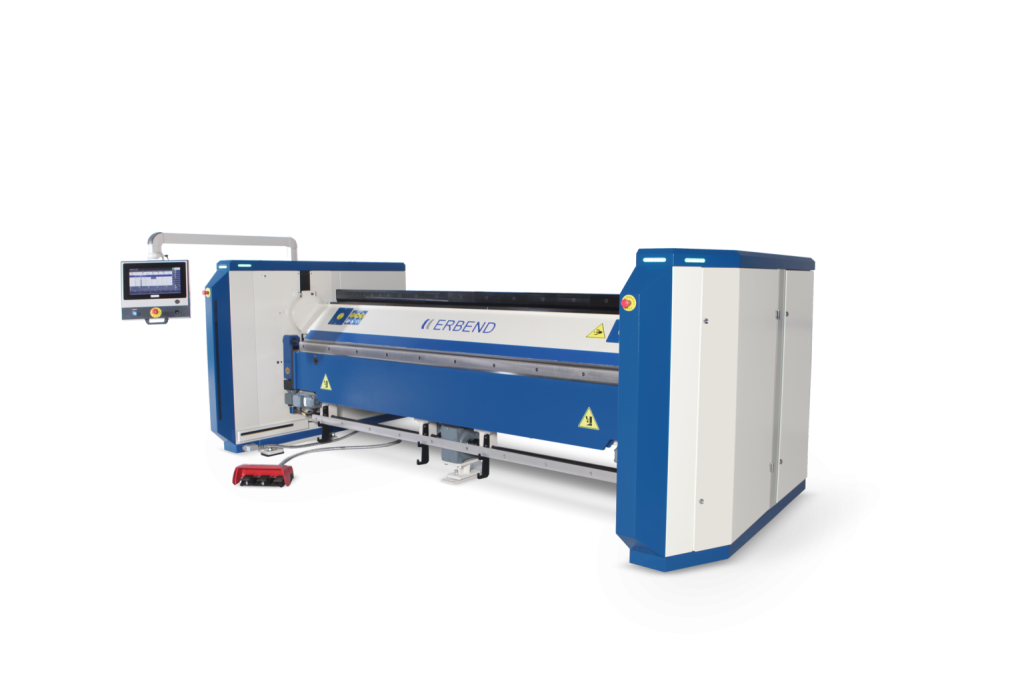
ERBEND MFD STEEL SHEET FOLDING MACHINE
Double Folders and Combi-Beam Technology
Two technologies continue to gain traction in U.S. fabrication environments:
Double Folders
Double folders use opposing folding beams to perform up and down bends without flipping the part. This reduces handling time and supports longer panels commonly used in roofing, architectural components, and structural applications. For coil-fed lines, eliminating part flipping directly reduces labor touchpoints.
Combi-Beam Folders
Combi-beam systems combine straight and segmented tooling in one machine, allowing operators to switch between profile types without manual tool changes. This is especially valuable for contract metalwork and commercial parts producers running varied SKUs.
Trade publications such as The Fabricator and MetalForming Magazine have highlighted how programmable folding reduces changeover time and supports high-mix production environments common in North American job shops.
Reducing Scrap and Rework in Coil-Fed Operations
Metal folding directly influences scrap rates. Misalignment, overbending, and inconsistent clamping pressure can drive costly rework—particularly when processing pre-painted or coated material.
Modern servo-driven folders address these risks by offering:
- Programmable bend angles with closed-loop feedback
- Adjustable clamping pressure for coated or thin-gauge materials
- Integrated backgauges for consistent positioning
- Digital part libraries to prevent setup variation between shifts
For industrial fabrication and automotive suppliers in Indiana, where contract tolerances are tight, these features directly affect first-pass yield and on-time delivery performance.
Safety and Ergonomics: A Growing Priority
Folding operations involve repetitive motion, pinch points, and heavy sheet handling. OSHA continues to emphasize machine guarding, ergonomic risk reduction, and safe material handling practices in metal fabrication environments.
Automated folders and panel benders reduce operator strain by:
- Eliminating repeated manual flipping of large sheets
- Incorporating light curtains and guarded bending zones
- Using programmable positioning instead of manual adjustment
- Reducing the number of operators required per shift
For production leaders focused on workforce retention and injury prevention, automation is increasingly a safety investment—not just a productivity decision.
Integration with the Modern Fabrication Line
Metal folding no longer operates in isolation. Leading shops integrate folders with:
- Fiber lasers for cut-to-fold workflows
- Automated tool libraries
- Production tracking systems
- Coil-fed slitters and cut-to-length systems
OEM guidance from companies like Salvagnini and CIDAN/Forstner emphasizes end-to-end material flow. When folding capacity lags behind cutting output, it becomes the bottleneck. When properly balanced, folding can increase total line efficiency and reduce WIP accumulation.
What Indiana Fabricators Should Evaluate in 2026
For shops across Mac-Tech Indiana’s service region, practical evaluation criteria include:
- Current changeover time per job
- Scrap and rework rates tied to folding errors
- Operator labor per shift at the folding station
- Material handling between cutting and forming
- Future mix of parts and profile complexity
In many cases, upgrading a folding system delivers faster ROI than adding additional cutting capacity—especially when high-mix production dominates.
The Bottom Line
Metal folding remains one of the most influential processes in modern sheet metal fabrication. Advances in CNC control, servo-driven motion, combi-beam tooling, and double-folder configurations are helping U.S. manufacturers improve consistency, reduce labor strain, and control material waste.
For industrial fabricators, automotive suppliers, structural component producers, and contract metal shops across Indiana, evaluating folding technology is not simply about machine replacement—it is about strengthening the entire production workflow.
Related Video
ERBEND MFA Combi CNC Sheet Metal Folder by Mac-Tech
Sources
- Salvagnini Panel Bending Systems – OEM documentation and technical resources (https://www.salvagnini.com/en-us/)
- RAS Systems – CNC Folding Technology Overview (https://www.ras-online.com/)
- The Fabricator – Industry coverage on press brakes and panel bending automation (https://www.thefabricator.com)
- MetalForming Magazine – Sheet metal forming and automation trends (https://www.metalformingmagazine.com)
- Occupational Safety and Health Administration (OSHA) – Machine guarding and fabrication safety guidelines (https://www.osha.gov)
Get Weekly Mac-Tech News & Updates
