
I am Kyle Bialozynski, Sales Executive at Mac-Tech here in Wisconsin. I grew up in a family that fixes things, measures twice, and gets it done right the first time. I spend my days on shop floors with production and operations managers sorting out real bottlenecks, not theory. I speak in plain language, I run sample parts, and I back recommendations with numbers. If you need me, call or text 414-704-8413 or email kyle@mac-tech.com.
Walk Your Shop With Me to Eliminate Bottlenecks Using HSG Acceleration, Instant Piercing, and Fly-Cut Paths
When I walk a Wisconsin shop, I look for three killers of throughput on cutting cells. Slow ramps, long pierce times, and wasted head travel between features. HSG fiber lasers attack all three. High acceleration gets you to cutting speed fast on every contour. Instant piercing and pierce detection remove the stop-and-wait time on thicker plate. Fly-cut paths let the head glide over a field of holes without stopping, which is ideal for perforations and bolt patterns.
Sales-based insight and solutions: The goal is not a high top speed that you never reach. It is higher average speed over the entire nest and fewer moments where the head is not cutting. On a 3×5 bracket with 18 holes, I typically see HSG fiber cut the cycle time by 35 to 55 percent compared to an older CO2. In Waukesha, one job shop moved a 3 mm stainless panel from 6 minutes on CO2 to 2 minutes 45 seconds on an HSG 6 kW fiber by using fly-cut on the hole grid and reducing pierce times to milliseconds.
Machine recommendations: For shops doing mixed gauge work up to 1 inch mild steel, the HSG flatbed fiber series in 6 kW to 12 kW with a 5×10 or 6×12 table covers most needs. Choose the shuttle table option for non-stop cutting while you unload. Add the high dynamic package that boosts acceleration and jerk control so small parts do not shake loose, which protects downstream bending accuracy.
Technical and logistical knowledge: To unlock acceleration benefits you need rigid floors, correct leveling, and a steady material feed. Place the laser so raw sheets can move straight from rack to load station and finished parts can exit onto kits bound for the press brake. A U-shaped cell with the load tower on one side and brake staging on the other reduces forklift trips and keeps the operator within 10 steps of both sides of the shuttle table.
Specific requirements and progressive assembly:
- Electrical power 480 V 3 phase with adequate kVA headroom for the laser, chiller, and dust collection. We verify amp draw by model.
- Clean dry air 120 psi for nozzle cleaning and assist gas changeover.
- Nest parts by assembly family so the next step is bending, hardware insertion, or welding without re-sorting. Use color coded carts and QR tags created by the nesting software to cut handling.
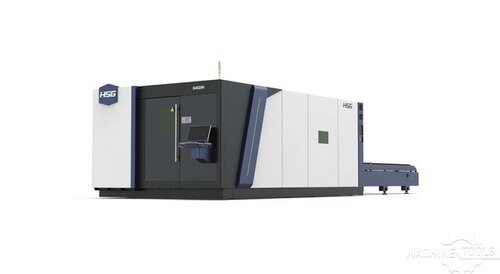
HSG 3015H 12KW
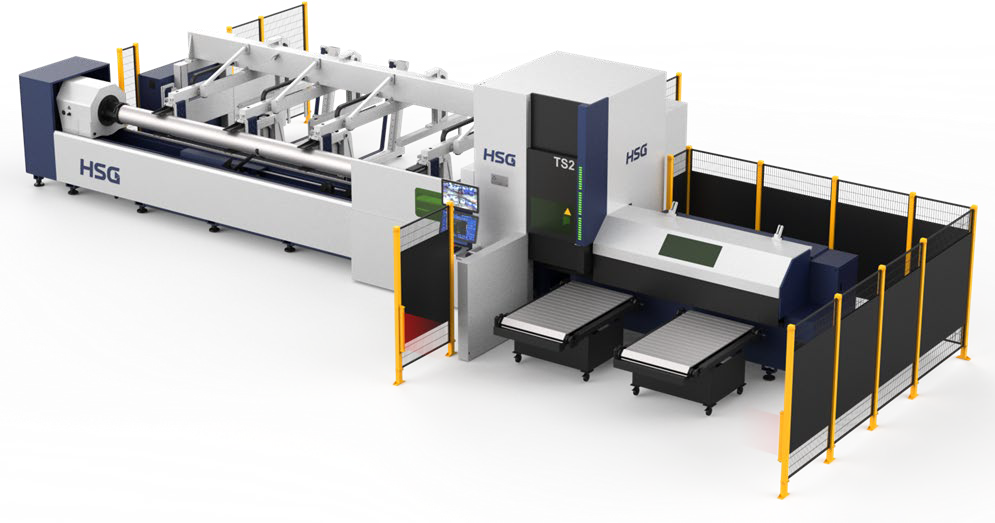
HSG TS2 V2.0 TUBE LASER CUTTING MACHINE
High-Speed Precision for Advanced Tube Processing
The HSG TS2 V2.0 delivers unmatched efficiency and accuracy in tube laser cutting. Equipped with a 6kW…
Replace Plasma and CO2 to Slash Rework: Clean Edges, Tight Kerf, Minimal Heat Affected Zone That Skip the Grinder
Plasma and older CO2 cells often burn time at the deburr bench. Dross, wide kerf, and a larger heat affected zone force you to grind edges and chase flatness. Fiber laser beam quality produces clean edges with a tight kerf that drops straight into the press brake. Less heat means parts stay flatter and bend predictably.
Sales-based insight and solutions: A Green Bay fabricator replaced a 260 amp plasma with an HSG 8 kW fiber laser. On 1/4 inch mild steel gussets they eliminated 70 percent of grinding hours and reclaimed 12 hours per week of labor. Scrap went down 2 percent because holes were on size and tabs fit the first time. Another shop in Appleton swapped a 4 kW CO2 for a 10 kW fiber and took a stainless cover from two grinding passes to none on 90 percent of parts by dialing in nitrogen assist and a sharper focus length.
Machine recommendations:
- For shops battling dross on 10 gauge to 1/2 inch mild steel, start with 6 to 8 kW and a high flow nozzle package.
- Add the autofocus cutting head with real-time height control to keep the cut consistent across sheets that are not perfectly flat.
- Consider a nozzle changer to maintain cut quality automatically on mixed materials.
Technical knowledge: The tighter spot size of fiber delivers higher energy density. That is why you get clean edges at higher speeds with a narrower kerf. With nitrogen assist you prevent oxidation, which means parts go straight to paint or powder without extra prep. For thicker mild steel where you want speed with oxygen, use fast pierce routines and ramped lead-ins to keep heat low at the edge.
Logistics and progressive assembly: By cutting clean edges and accurate tabs, you reduce fit-up time at welding. Set up a flow where parts leave the laser, get a quick tumble if needed, then go in kits to the brake and hardware cells. Your welders spend time welding, not grinding. The net effect is fewer work in process piles and a smoother daily schedule.
Turn Power Into Profit with Fiber Efficiency, Smart Gas Control, and Auto Nesting That Lift Parts per Shift
Fiber lasers convert more of the electricity into cutting power than CO2. They also have fewer consumables to replace. Combine that with smart gas control and a nesting engine that squeezes more parts into every sheet and your parts per shift go up while cost per part goes down.
Sales-based insight and solutions: A Milwaukee OEM moving from CO2 to 12 kW fiber increased throughput on 3/16 inch mild steel by 2.7 times and dropped electrical consumption on the cutting cell by roughly 40 percent per part. Switching to nitrogen on stainless eliminated the secondary cleaning step and saved 6 hours per week. When they turned on auto nesting with common-line cutting, they saved 8 percent material on recurring jobs and cut handling because skeletons came off in larger manageable sections.
Machine recommendations:
- 3 to 6 kW for thin gauge production parts and mixed metals up to 3/8 inch.
- 8 to 12 kW for thicker mild steel and high volume stainless.
- Add smart gas control that can switch between nitrogen, oxygen, and shop air recipes by material and thickness.
- Integrate auto nesting software that supports remnants, part rotation rules, and common-line.
Technical knowledge: Smart gas control meters flow and pressure so you do not over-consume nitrogen. For many gauges, shop-air assist on mild steel can be viable for cost control. Auto nesting with remnant tracking lets you scan a leftover sheet, load its geometry, and fill it automatically with priority jobs. Fly-cut reduces pierce counts in hole-intensive parts which protects nozzles and saves seconds that add up to hours each week.
Logistics and progressive assembly: With higher parts per sheet and fewer pierces, your load-unload rhythm gets predictable. Use a shuttle table and overhead vacuum loader so the operator can stage the next sheet while the machine cuts. Kit directly onto carts labeled by bend sequence and deliver to the closest brake. This reduces backtracking and lets you run a progressive assembly flow with fewer touches.
Spec the Right HSG for Your Parts Mix: Power, Bed Size, Autofocus Head, and Lights-Out Automation That Scale With You
Right-sizing the machine to your parts mix is where I spend the most time with customers. Buying too little power slows your thick plate jobs. Buying too much power without the right upstream and downstream flow can starve the machine.
Sales-based insight and solutions: We start by sampling your five highest hour part numbers. We compare cycle times and edge quality at 6, 8, 10, and 12 kW. We look at sheet size to determine 5×10 vs 6×12 beds. If you plan to run nights, we add a load-unload tower and nozzle cleaning so you can cut unattended. In Oshkosh, a farm equipment builder started with an HSG 6 kW 5×10 and a shuttle table, then added a 6-shelf tower six months later after orders spiked. Their step-up plan avoided overbuying and kept cash flow clean.
Machine recommendations:
- HSG flatbed fiber 3015 size for 5×10 sheets, 4020 size for 6×12 sheets.
- Power: 6 kW for mixed gauge, 8 to 10 kW if 1/2 inch plate is routine, 12 kW for heavy stainless throughput.
- Autofocus cutting head with collision protection and height sensing.
- Shuttle table standard, add tower automation when you are ready for lights-out.
- If you cut tube or angle, pair a TS series tube fiber laser with a bundle loader.
Technical and logistical requirements:
- Floor space planning that allows loader clearance on one side and forklift aisles that do not cross operator travel paths.
- Dust and fume collection sized to the bed and materials.
- Chiller sized to the laser power and ambient temperature.
- Gas storage with safe lines for nitrogen and oxygen, or consider a nitrogen generator if usage is high.
- Verify power at the panel. A 10 to 12 kW fiber can require 80 to 120 kVA depending on options. We confirm with the exact spec sheet.
Progressive assembly and handling: Map where parts go next. If the next step is bending, place the brake cell to the right of the shuttle exit and stage press brake tooling by the most common families. If the next step is hardware, include part marking at the laser so operators can see part numbers and bend lines. Small wins in layout equal big wins in daily throughput.
Win Bids at Your Conference Table: ROI Math, Financing, and a Ramp Plan That Pays Back Fast
Fiber laser ROI is straightforward when you turn speed and quality into billable parts with less labor. We will run the math with your real jobs.
Simple ROI model:
- Current parts per hour on plasma or CO2 vs projected on fiber.
- Labor hours saved in grinding and rework.
- Material savings from better nesting and less scrap.
- Energy and consumables savings.
Example from Racine:
- Old process 45 brackets per hour with 20 minutes of grinding per sheet.
- HSG 8 kW fiber 110 brackets per hour with 0 to 5 minutes of touch up.
- Labor save 12 hours per week, material save 6 percent through nesting, overtime cut by half.
- Payback 17 months on a financed purchase with Section 179 tax benefit.
Financing options:
- 60 to 72 month fixed payment with low upfront.
- Seasonal payment structures for agriculture and construction cycles.
- Section 179 and bonus depreciation where applicable.
- Trade-in value for your plasma or CO2 to reduce capital outlay.
Ramp plan:
- Phase 1 install and operator training with your top 10 repeat jobs.
- Phase 2 nesting rules tuned to your kitting and remnant plan.
- Phase 3 lights-out on stable jobs with nozzle cleaning and scheduled inspections.
- Phase 4 bring in more work from vendors you used to outsource.
We build a realistic schedule so you are not learning while behind. You will see wins in the first 30 days.
Count on Mac-Tech After the Install: Onsite Training, Preventive Service, and Fast Parts Support to Keep Uptime High
Machines make you money when they run. Support keeps them running. Mac-Tech has local techs, stocked parts, and phone support in Central Time so you are not waiting on overseas hours.
Onsite training: We train operators, programmers, and maintenance staff. We cover setup, lens and nozzle care, cut libraries, gas recipes, and daily checks. We leave you with documented job setups for your top part numbers so you hit the ground running.
Preventive service: We schedule quarterly or semiannual PMs based on usage. We check optics, bellows, linear ways, filters, chiller performance, and software updates. This avoids unplanned downtime and protects cut quality.
Fast parts support: Common wear items like nozzles, ceramic rings, lenses, filters, and sensor cables are stocked in Wisconsin. For larger items, we ship same day when possible. Remote diagnostics shorten troubleshooting. If you need an onsite visit, we coordinate around your production schedule to minimize disruption.
Logistics to protect uptime: Keep spare lenses, nozzles, and alignment targets on site. Set up a clean bench with nitrile gloves and lens wipes. Log every collision or tip-up event so we can trace issues. Assign basic daily checks to operators and weekly checks to maintenance. These small habits keep your OEE high and your parts on schedule.
FAQ
How much faster is fiber vs plasma or CO2 in real shops
- It is common to see 2 to 3 times faster on thin to mid gauge, with 20 to 50 percent faster on thicker mild steel, plus big time saved from skipping grinding.
Do I need 12 kW to see a return
- Not always. Many Wisconsin shops see strong ROI at 6 to 8 kW because the workflow and clean edges drive the gains.
What are the real operating cost differences
- Fiber uses less electricity, fewer consumables, and lower maintenance than CO2. Gas costs depend on your mix of nitrogen, oxygen, and air, which we optimize.
Can I run lights-out safely
- Yes with the right jobs, stable nests, nozzle cleaning, tip-up avoidance, and a load-unload system. We start nights on repeat runners.
What power and facilities do I need
- 480 V 3 phase, clean dry air, fume extraction, and floor space for the bed plus loader. We verify exact amperage and CFM with the chosen model.
Will fiber replace my plasma for thick plate
- For many parts up to 1 inch mild steel, yes. If you cut very thick or rusty plate, you may keep plasma for those jobs and let fiber handle everything else faster.
- Can Mac-Tech help with programming and nesting
- Yes. We provide training, nesting templates, remnant workflows, and can assist with post processors and ERP integration.
If you want to see your parts run on an HSG fiber laser or walk your floor together to identify the fastest path to ROI, I would be happy to help. Call or text me at 414-704-8413 or email kyle@mac-tech.com. No pressure, just straight answers and real numbers.
Get Weekly Mac-Tech News & Updates
