
Why Preventive Maintenance Matters More in 2026
.For fabricators across Indiana, Illinois, Michigan, and the greater Midwest, preventive maintenance (PM) is no longer just a reliability best practice—it is a compliance and profitability strategy.
OSHA renewed its National Emphasis Program (NEP) on amputations in manufacturing in June 2025, signaling sustained inspection focus on machinery safety, servicing, and maintenance procedures. At the same time, OSHA continues to prioritize lockout/tagout (LOTO), machine guarding, and hazard communication in manufacturing environments.
For shops running fiber lasers, press brakes, tube lasers, saws, and structural processing equipment, that means two realities:
- Unplanned downtime is expensive.
- Poorly managed maintenance can also become a compliance risk.
A structured preventive maintenance program addresses both.
OSHA Enforcement and Maintenance: What’s Changed
Recent OSHA updates and enforcement communications emphasize machine safety during operation, servicing, and maintenance. QuickTakes notices in late 2025 and early 2026 highlighted machine-related fatalities and reinforced hazard prevention and control during cleaning, servicing, and repair activities.
Under the renewed NEP, manufacturing facilities remain a priority for inspection when hazards involving machinery are present. For Midwest fabricators operating press brakes, shears, structural beam lines, or automated laser cells, documented maintenance procedures and energy control programs are critical.
In practical terms, that means:
- Documented LOTO procedures for every major machine.
- Training records tied to maintenance tasks.
- Proof of routine inspections and corrective actions.
- Clear ownership of PM responsibilities.
Preventive maintenance is no longer just about extending equipment life—it is part of your safety management system.

Fibertube
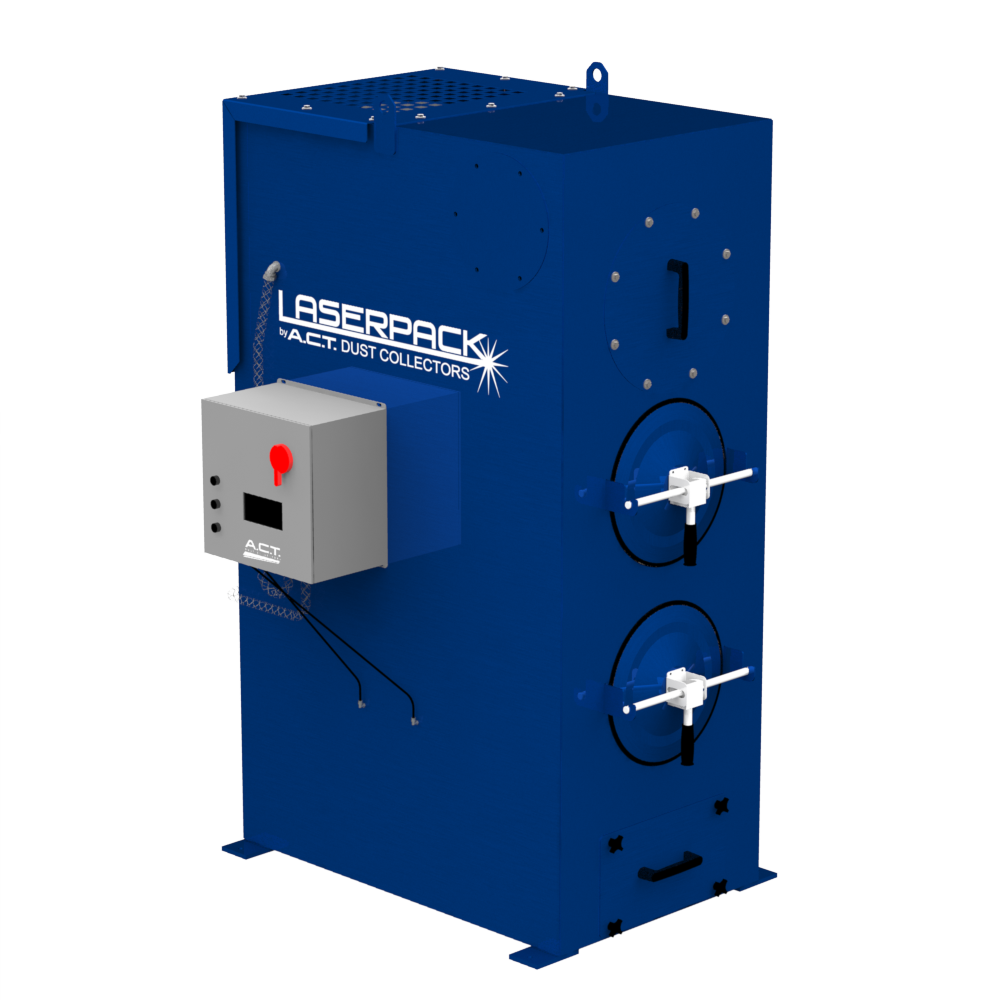
ACT LASERPACK 2 DUST COLLECTOR
From Reactive to Predictive: How OEMs Are Shaping Maintenance Strategy
Leading OEMs such as TRUMPF now integrate condition monitoring and machine diagnostics to support predictive maintenance. These systems monitor components like pumps, drives, and laser subsystems to detect anomalies before failure.
For example, machine diagnostics can flag abnormal vibration or vacuum pump behavior in laser systems, allowing service teams to schedule repair before beam failure halts production.
For Midwest contract metalwork and automotive suppliers operating high-utilization equipment, the shift looks like this:
- Reactive: Fix after failure.
- Preventive: Service on time or cycle intervals.
- Predictive: Service based on real performance data.
Shops that combine OEM diagnostics with internal PM scheduling see measurable gains in uptime and reduced emergency service costs.
What Preventive Maintenance Protects in a Fabrication Shop
1. Production Throughput
In structural steel and aluminum component production, a down press brake or fiber laser can stall downstream welding, forming, or assembly. A missed shipment to an automotive customer can cost far more than a scheduled service window.
2. Safety and Compliance
Machine guarding, energy isolation, and proper maintenance documentation directly support OSHA compliance. With manufacturing injury reporting deadlines and ongoing enforcement programs in place for 2026, a documented PM program strengthens your defensibility during inspections.
3. Equipment ROI
Capital equipment investments—whether a CNC press brake, tube laser, or beam coping system—are long-term assets. Routine lubrication, calibration, filter changes, alignment checks, and hydraulic inspections extend service life and preserve accuracy.
Inaccurate bends, inconsistent laser cuts, or drifting backgauges are often early indicators of deferred maintenance.
Core Elements of a Strong PM Program
For fabrication businesses in Indianapolis, Gary, Elkhart, Fort Wayne, and throughout the region, an effective preventive maintenance program should include:
- Daily operator checks: Visual inspections, lubrication confirmation, abnormal noise reporting.
- Scheduled PM intervals: Based on OEM guidelines and actual machine utilization.
- Hydraulic system monitoring: Oil condition, filter changes, leak inspection.
- Calibration and alignment verification: Especially for press brakes and structural processing systems.
- Energy control audits: Verification of LOTO compliance during service tasks.
- Digital tracking: CMMS or structured logs to document completion and corrective actions.
Many shops struggle not because they lack maintenance knowledge, but because production pressure pushes PM tasks aside. In high-mix, high-demand environments, leadership commitment is what keeps PM on schedule.
Midwest Reality: Balancing Throughput and Maintenance
Fabricators serving heavy equipment and automotive supply chains often operate extended shifts. It can feel impossible to take machines offline for service.
But the cost of deferral compounds:
- Minor hydraulic contamination becomes pump damage.
- Ignored vibration becomes bearing failure.
- Skipped calibration becomes scrap and rework.
Preventive maintenance is not lost production time—it is controlled downtime that prevents uncontrolled downtime.
Looking Ahead: 2026 and Beyond
With OSHA maintaining enforcement focus in manufacturing and OEMs expanding condition monitoring capabilities, preventive maintenance is evolving into a strategic advantage.
Shops that treat PM as part of their business model—not just a maintenance department task—position themselves for:
- Stronger safety records.
- Better inspection outcomes.
- Improved customer confidence.
- Higher long-term equipment ROI.
If you are evaluating your current maintenance approach—whether for lasers, press brakes, saws, structural systems, or full production lines—now is the time to ask: Is your preventive maintenance program protecting your uptime and your compliance, or just reacting to breakdowns?
We invite you to think through your current maintenance strategy and use the contact form below to ask questions, share challenges, or explore how a structured preventive maintenance plan can better support your operation. Tapping into experienced guidance can help you move from reactive fixes to a disciplined, profitable maintenance strategy.
Sources
- OSHA QuickTakes (December 15, 2025; January 30, 2026) – Machine safety and injury reporting updates
- OSHA National Emphasis Program on Amputations in Manufacturing (renewed June 2025)
- Bloomberg Law – Safety agencies enforcement outlook for 2026 (December 2025)
- TRUMPF – Condition Monitoring and Machine Diagnostics
Get Weekly Mac-Tech News & Updates
